


Bréguet Br.960 Vultur: The French Jet That Also Carried a Propeller by Fortuné Leroy | Sep 18, 2026 | History & Legends, Military Aviation | 0 comments
In November 1947 the French naval air arm wrote a specification for a carrier aircraft that could do two things. It had to loiter for four hours at low level hunting submarines, and it had to be able to dash at 700 km/h.
Those are not two requirements. They are two aeroplanes.
Bréguet’s response was to build both of them into one airframe. The Br.960 Vultur had an Armstrong Siddeley Mamba turboprop in the nose, driving a propeller, and a Rolls-Royce Nene turbojet in the tail, breathing through ducts in the wing roots. Two built. Neither entered service. And yet the second one ended up flying, in a manner of speaking, until the year 2000.
Aircraft: Bréguet Br.960 Vultur (“Vulture”), carrier attack and anti-submarine prototype
Origin: Aéronavale specification of 12 November 1947
Layout: Turboprop in the nose, turbojet in the tail. Side-by-side crew of two
Nose engine: Armstrong Siddeley Mamba. 970 shp on the first prototype, 1,320 shp on the second
Tail engine: Rolls-Royce Nene, 4,900 to 5,000 lbf, fed through wing-root ducts
First flight: 4 August 1951. Second prototype 15 September 1952
Fate: The second prototype was rebuilt as the Br.965 Épaulard, then led to the Br.1050 Alizé
The Aéronavale wanted an aircraft that could carry bombs, depth charges, guided missiles, rockets and torpedoes, take off with rocket assistance, stay airborne for four hours at sea level, reach anything between 300 and 700 km/h, land at under 155 km/h, and carry armour for the crew.
Bréguet looked at that list and concluded, correctly, that no single powerplant available in 1947 could deliver both ends of the speed range. A turboprop is efficient at low speed and runs out of usefulness as it goes faster. A turbojet of the period was thirsty at low level and hopeless at loitering. Pick one and you fail half the specification.
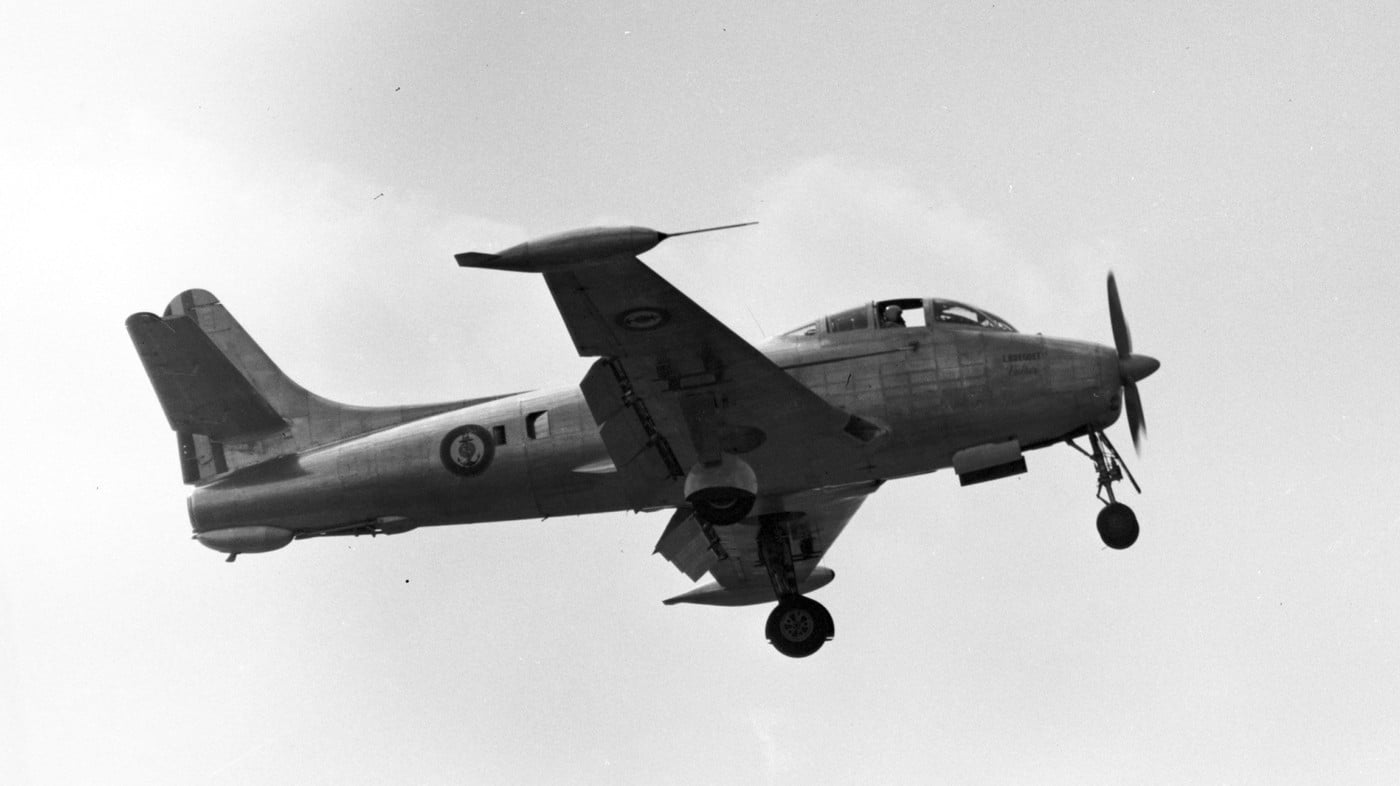
The Vultur carried its two engines at opposite ends of the fuselage. The turboprop gave endurance, the turbojet gave speed, and the aircraft used whichever the mission required. The Shape of the Compromise The Vultur was a low-wing monoplane with an oval monocoque fuselage and tricycle landing gear. Its two-spar wing had a swept leading edge and a straight trailing edge, and folded vertically on hydraulics for carrier stowage. The tailplane was swept too, with 16 degrees of dihedral. The pilot and copilot sat side by side under a framed canopy.
Fuel went into a 600-litre self-sealing tank in the fuselage and a 350-litre self-sealing tank in each outer wing panel. A single hardpoint under the fuselage could carry 1,000 kg, or a container holding a more powerful search radar. Four underwing launchers took two rockets each.
The first prototype flew on 4 August 1951 with a 970 shp Mamba I and a Nene 101 of 21.6 kN. It was badly underpowered. It could not be flown at full load at all unless the jet was running, which rather undermined the point of having a fuel-efficient turboprop in the nose.
The Vultur at Le Bourget in 1953, with BREGUET Vultur painted on the nose. The propeller and the jet pipe belonged to the same aeroplane. Photo: Wikimedia Commons. The Second One Worked The second prototype flew on 15 September 1952 with a 1,320 shp Mamba III and a 22.2 kN Nene. It carried small nacelles on the wingtips: fuel to port, an attack radar to starboard.
It met every requirement of the specification. And here the story produces one of those details that says more about post-war European aviation than any amount of analysis.