
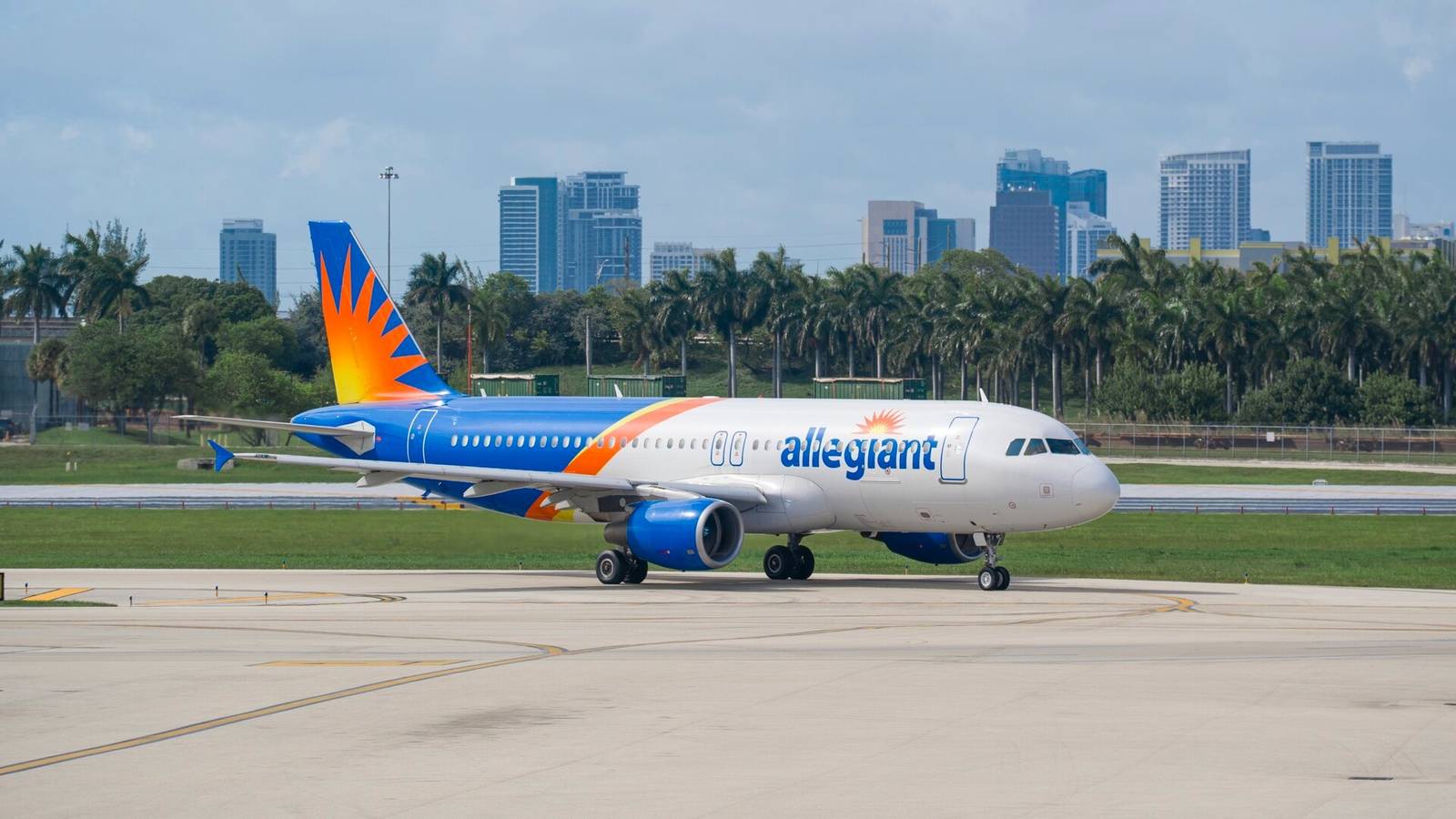


Allegiant Air has been making a lot of changes to its network, and for avid Simple Flying readers, the picture may appear confusing at first glance. One day, the airline is making headlines for cutting dozens of routes; a few days later, it is in the news for a large Florida-focused expansion. Both stories are true, but they make a lot more sense when viewed together.
The wider picture is that Allegiant is reshaping its network as higher fuel costs, the closure of Spirit Airlines, and the completed Sun Country Airlines acquisition have all changed the carrier’s strategic backdrop. The result is a reshuffling of Allegiant’s largest airports, with Florida gaining even more importance, while some West Coast stations have been eliminated and even the mighty Las Vegas has been losing ground.
Florida Still Dominates Allegiant’s Biggest Airports
To understand the re-shuffle, we’ll look at Allegiant’s flight data from Cirium for July–December 2026, and do a direct comparison to the second half of last year. What is immediately apparent is that Orlando Sanford International Airport (SFB) remains Allegiant’s largest airport by a wide margin, with more than 10,000 flights in the back half of this year. Allegiant has a 99% market share at Orlando’s second airport, with Arajet as the only other carrier, operating a three-times-weekly service to Punta Cana in the Dominican Republic.
St. Pete–Clearwater International Airport (PIE) remains in a solid second place in Allegiant’s network, being the airline’s gateway for the Tampa Bay area, with an average of 50 daily flights to more than 60 different destinations. Like SFB, Allegiant dominates PIE as the sole carrier, although the airport will be welcoming BermudAir later this year when the Caribbean carrier is set to add three new routes.
St. Pete–Clearwater International Airport (PIE)
Fort Lauderdale-Hollywood International Airport (FLL)
Cincinnati/Northern Kentucky International Airport (CVG)
The table is heavily tilted toward Florida or Florida-adjacent leisure demand. Half of the top ten are Florida leisure destinations, and three more (TYS, CVG, and AVL) are bases where Allegiant flies almost exclusively to Florida destinations. What is equally apparent is that West Coast destinations don’t feature on the list at all, with Allegiant having fully exited large airports such as Los Angeles International Airport (LAX), Oakland International Airport (OAK), and San Diego International Airport (SAN) over the past year.
Despite all the network noise, there is only one change in the top 10 itself. Sarasota-Bradenton International Airport (SRQ) has been replaced by Destin-Fort Walton Beach Airport (VPS), which enters the list in 10th place. VPS is a unique joint-use commercial facility situated within Eglin Air Force Base. The airport does not own its own runways; instead, civilian airliners share tarmac with military aircraft, and it’s a favorite with aviation enthusiasts as passengers frequently witness military fighter jets during take-off or landing.
Situated at the heart of the Emerald Coast, Destin-Fort Walton is also one of the fastest-growing airports in the United States, with air service more than doubling since pre-pandemic levels. Allegiant has its own dedicated Concourse C, an $11.4 million expansion that opened in 2022, from where it operates to 34 destinations, with Denver International Airport (DEN) and Columbia (COU) added in recent months.
Fort Lauderdale-Hollywood International Airport (FLL) is the standout winner in Allegiant’s second-half 2026 schedule. The airport will have nearly 5,000 Allegiant flights in the second half of this year, up 33% over the same period last year. That is due to an increase of over 1,200 flights or approximately 7 additional flights per day, on average, by far the biggest gain among Allegiant’s top airports.
Changes At Fort Lauderdale-Hollywood International Airport
Albany, Boston, Chattanooga, Kansas City, Omaha, Pittsburgh, Chicago Rockford, Rochester, Trenton
The route-level data explains why. Allegiant will have added nine new routes from Fort Lauderdale by the time the second half of 2026 rolls around. These range from large hubs like Boston Logan International Airport (BOS) to much thinner routes like Chattanooga Metropolitan Airport (CHA), where Allegiant will be the sole carrier operating. In addition, the carrier has been adding capacity to its existing 34 destinations, which jointly contributes to the 33% increase in flights.
The bigger strategic point is that Fort Lauderdale has become a much more attractive opportunity following the demise of Spirit Airlines, which was once the defining low-cost carrier at FLL. JetBlue has spent the past year adding new routes at FLL at a prodigious rate, taking advantage of Spirit’s weakness, and is now the number one carrier from the South Florida hub. But the data shows that it is not alone, with Allegiant having grown its FLL flying by 26% this quarter, and with even steeper growth in the back half of the year.
They involve nine Florida airports. Find out more here!
Las Vegas’ Harry Reid International Airport (LAS) remains Allegiant’s third-largest airport with nearly 7,000 flights in 2H 2026, but it is the clear loser among the top ten. It will have a 9% reduction in flights, or approximately 4 fewer departures per day on average, after six destinations have been removed from the network.
Phoenix-Mesa, Nashville, Boise, Akron-Canton, Chattanooga, Chicago Midway
The fall off at Las Vegas is in line with the industry at large, as multiple airlines have scaled back their operations to Sin City, which reports an approximately 5% reduction in visitors year-over-year. Interestingly, while six routes have been dropped, Allegiant has added one, the only red-eye flight across its entire network, which departs once a week on Fridays for Orlando Sanford.
Of course, Las Vegas still remains a very important part of Allegiant’s leisure-centric flying as its third-largest airport. But the year-over-year changes are indicative of the bigger shifts happening within the carrier’s network. It is responding rapidly to increased Florida demand, particularly after Spirit’s closure, while simultaneously pruning weaker “spokes” from its key bases. The result is a more dynamic and selective Allegiant: bigger in key Florida markets, more cautious out west, and increasingly focused on building a stronger leisure platform for the next phase of growth.
Orijinal Haberi Görüntüle