
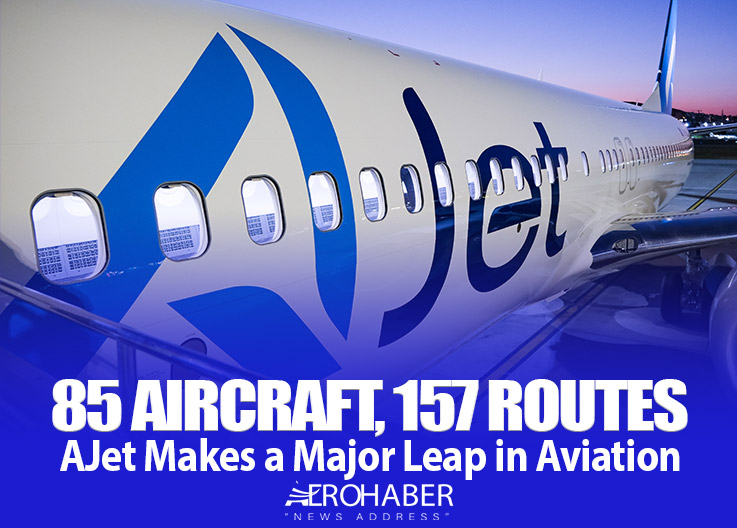


AJet increased its international capacity share to 63.4 percent in the first quarter of 2026, while raising its passenger numbers to 5.7 million. The low-cost brand of Turkish Airlines is deepening its Sabiha Gökçen-based growth on a global scale.
From Domestic Carrier to Regional Power: AJet’s Transformation Story Accelerates
Positioned as the next-generation growth platform of the Turkish Airlines ecosystem, AJet has clearly demonstrated both its fleet expansion and strategic transformation in its business model with its first-quarter 2026 data. The announced operational indicators show that the brand has moved away from its traditional domestic-focused structure and is aggressively positioning itself in the international market.
The operation, which had a fleet of 31 aircraft in 2019, reached 85 active aircraft in the first quarter of 2026. This growth represents a much more ambitious scale in the low-cost carrier segment of Turkish civil aviation.
International Capacity Now at the Core
AJet’s most striking transformation has occurred in its capacity composition. The share of international operations, which stood at 13.3 percent of total capacity in 2019, rose to 58.5 percent in the first quarter of 2025 and to 63.4 percent in the same period of 2026.
A Strengthening Player at Sabiha Gökçen
AJet’s international market share at Istanbul Sabiha Gökçen Airport has also grown significantly. Its share, which was 18 percent in 2019, increased to 24 percent in the first quarter of 2025 and to 27 percent in the first quarter of 2026.
AJet has become more visible at Sabiha Gökçen—where competition, particularly driven by Pegasus, is intense—and has gained strength in terms of slots and efficiency.
Strong Recovery in Passenger Numbers and Load Factor
AJet, which carried 4.6 million passengers in the first quarter of 2025, increased this figure to 5.7 million in the same period of 2026. ASK-based capacity rose from 6 billion to 7 billion, while the load factor reached 85.4 percent, up from 78.6 percent.
This improvement sends two critical messages:
- Increasing capacity is being met by demand
- Network optimisation and route selection are becoming more efficient
As load factor is a critical indicator for low-cost airlines, this increase shows that AJet’s commercial model is beginning to mature.
Increase in Number of Routes: Network Deepens
The number of routes, which was 129 in 2019, increased to 157 in the first quarter of 2026.
The Turkish diaspora in Europe, the Balkans, Gulf connections and tourist destinations constitute natural growth areas for AJet.
A Strategic Complementary Role for Turkish Airlines
AJet’s rise is an important part of Turkish Airlines’ strategy to create a multi-layered revenue model.
Thanks to this structure:
- The THY main brand generates premium revenue
- AJet grows in the price-focused segment
- Turkish Cargo creates scale in logistics
Thus, the group can manage different passenger segments without weakening each other.
2026 Message: AJet Is No Longer a “New Brand”
The first-quarter data shows that AJet has moved beyond its post-establishment transition period and has become a true growth platform. The simultaneous increase in fleet, routes, passengers, load factor and international capacity data indicates that the brand will be able to play a stronger role in regional aviation competition originating from Türkiye in the coming period.