
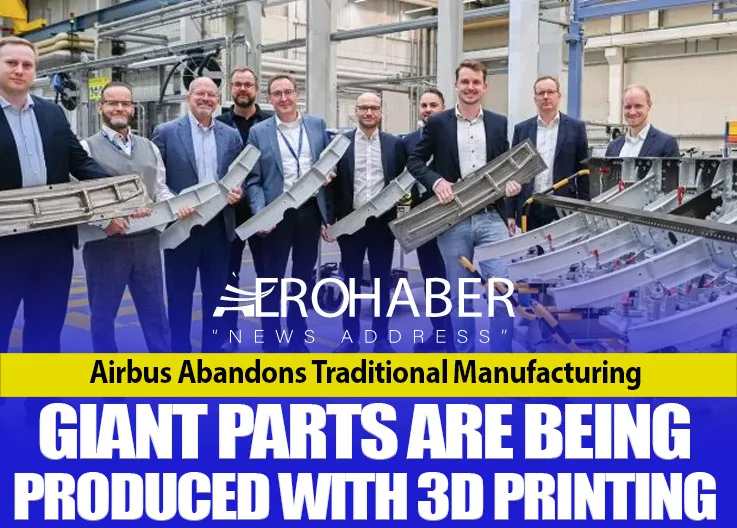


Airbus has started producing titanium aircraft parts using wire-directed energy deposition (w-DED) technology through 3D printing instead of machining them from metal blocks. The new method reduces both costs and raw material waste, while ushering in a new era for the aerospace industry in the production of large and critical structural components.
The Aerospace Industry Is Moving Beyond the Conventional
Aircraft parts traditionally produced by machining metal blocks are now being replaced by structural components built layer by layer from a wire spool. This innovative approach, implemented at Airbus facilities, signals a fundamental transformation in the production of parts designed to withstand the most demanding stress and fatigue conditions of passenger aircraft.
At the heart of this transformation is an advanced 3D printing technology called wire-directed energy deposition (w-DED). Thanks to this method, Airbus can manufacture large and critical titanium aircraft parts far more efficiently compared to traditional forging and subtractive manufacturing techniques.
How Does w-DED Work?
w-DED technology uses a multi-axis robotic arm equipped with a titanium wire spool. High-energy sources such as lasers, plasma, or electron beams instantly melt the titanium wire and fuse it to the surface layer by layer. Although the process resembles welding on the surface, it is guided by a digital 3D model and builds the part from scratch.
The resulting product is a “near-net-shape” blank that is very close to the final design. As a result, subsequent machining operations are reduced to a minimum.

3D Printing Paves the Way for Large Structural Parts
Although metal 3D printing technologies have been used in the aerospace sector for around a decade, they have generally been limited to small-scale parts. Powder-bed systems were not suitable for large structural components due to size constraints.
w-DED eliminates this limitation. Using this technology, Airbus can produce titanium parts exceeding 7 metres in length. With production capacities ranging from hundreds of grams per hour to several kilograms, the method makes 3D printing suitable for serial production for commercial aircraft.
Titanium Waste Becomes a Thing of the Past
Titanium is an indispensable material in modern aircraft due to its light weight, strength, and compatibility with carbon-fibre composites. However, it is also an extremely valuable raw material. In traditional forging methods, 80 to 95 per cent of the purchased titanium can turn into waste during machining.
Thanks to the w-DED method, this waste is largely eliminated. Because the part is produced very close to its final shape, the “buy-to-fly” ratio is significantly improved.

Aircraft Development Processes Are Accelerating
Traditional die-forging processes require costly equipment and preparation times of up to two years. With w-DED technology, part geometry is defined entirely digitally, and production time is reduced to weeks. This agility provides a major advantage, particularly during the development phases of new aircraft programmes.
First Serial Integration on the A350
Airbus has begun producing some large structural parts located around the cargo door of the A350 using the w-DED method. These parts, printed using plasma w-DED, were subjected to ultrasonic testing before being machined and assembled at Airbus facilities. While offering exactly the same functionality as their traditionally forged counterparts, the parts deliver real-time cost advantages.

The Era of “Designed for DED”
This technology allows engineers to design single-piece, optimised components instead of multi-part assemblies. The “designed for DED” approach simplifies the supply chain, reduces assembly labour, and expands the design potential of next-generation passenger aircraft.
The Race Is Accelerating
Airbus and its partners continue to test different energy sources such as plasma, laser, arc welding, and electron beams to make w-DED technology an industrial standard. In the long term, the goal is to use this method in even more critical aircraft components such as wings and landing gear.