


Journalist – Aaron is an aviation and travel journalist with 14 years of experience in the travel and tourism industry. His background spans airport operations, aviation infrastructure, and travel consulting, having worked with global organizations across New Zealand, Europe, and North America. Combining industry expertise with firsthand travel experience across more than 52 countries and five continents, Aaron covers airlines, airports, aviation policy, and the wider travel sector. He is based in Canterbury, New Zealand. His work has been published in Simple Flying and featured by MSN, SAM CHUI Aviation & Travel, EIN News, Pakistan Defence, and Climate Depot.
Airbus is gearing up for the A350 Freighter to take its maiden flight this September. This will open the door for Airbus to compete more strongly in the airborne trade sector, one that has long been dominated by Boeing. For the European aircraft manufacturer, it is setting its sights on September for the A350F to take flight, with a strict timeline in which it hopes to achieve first delivery by the end of 2027.
As reported by Reuters, while the A350F is expected to make its maiden flight by next month, any small hiccup could see the timeline slip into October. Airbus is hoping to keep up momentum on this game-changing aircraft, with the goal of achieving flight testing and first delivery by the end of next year.
The First A350F Could Take Flight In September
September is expected to be the month when Airbus will see the A350F take flight for the first time, ahead of previous predictions which had placed the first test flight to be undertaken closer to the end of the year. The manufacturer then hopes to have the first delivery to customers in the second half of 2027.
Airbus launched the A350F specification in 2021, with an initial goal of having the type flying by 2025. This was knocked back and is now predicted for delivery next year. The freighter version of the popular A350 long-haul jet will be expected to break the dominance held by Boeing in the trade sector.
To date, Airbus has sold a total of 107 of the A350F composite, lightweight aircraft, a vast improvement when compared to the A330F, which achieved a total of just 38 orders and deliveries.
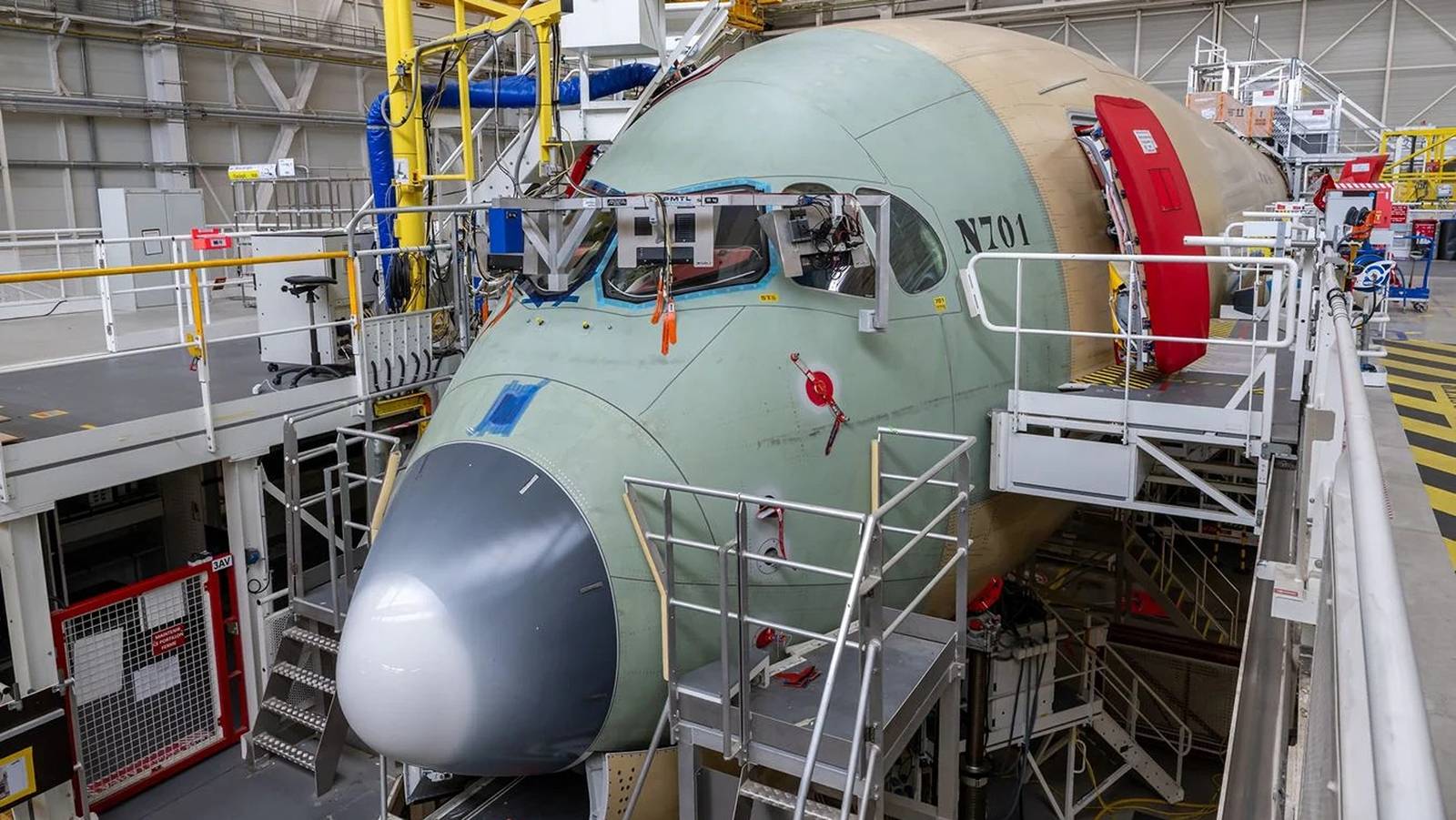
Airbus’ A350F is the rival to Boeing’s 777-8F cargo jet. While its service entry has been delayed, the A350F is being developed as one of the world’s next-generation freighters. This aircraft is designed with a high level of commonality when compared to the A330, and its first frame commenced construction in 2025.
The A350F is the first freighter to be based on a modern aircraft, using extensive advanced lightweight composites. This is not a clean-sheet aircraft, but has around 30% in advanced materials. The airplane is much lighter and expected to be less maintenance-intensive when compared to its rival. The aircraft’s structure, including the wings, fuselage panels, and center wing box, is made from composites, resulting in the plane being more rigid, lighter, and cost-efficient.
Airbus has boasted that the A350F will provide its customers up to 65 more revenue days across its service life of 16 years, thanks to reduced maintenance demands when compared to the 777-8F, a statement that Boeing likely will dispute for its freighter. The A350F is already based on a popular aircraft, the A350-1000F, an airplane that is already defying odds with ultra-long-haul flights, including the upcoming Qantas Project Sunrise, where the Australian flag carrier will connect Sydney Kingsford Smith Airport (SYD) to London Heathrow Airport (LHR) and New York JFK Airport (JFK) nonstop with regular scheduled flights for the first time.
A lightweight and efficient large freighter to threaten Boeing’s market dominance.
The largest order thus far for the A350F has gone to Atlas Air, which will become the largest operator of the type with deliveries scheduled between 2029 and 2034. Atlas, which placed its order for the aircraft in March 2026, is planning to use these airplanes to complement its extensive existing fleet while also handling long-term growth as 747-400 airframes retire. Other notable orders are listed below, as per data from ch-aviation, and listed by quantity:
The A350F is expected to be a popular choice for operators, due to its lightweight carbon-fiber composite airframe, while utilizing the modern Rolls-Royce Trent XWB engines. The new design is expected to offer up to 20% improved fuel efficiency and a drop in CO2 emissions. It is suggested that it will offer up to 40% better fuel efficiency when compared to the 747F.
Orijinal Haberi Görüntüle