


United States Air Force has deployed its F-22 Raptors, known as the world’s most advanced stealth fighter jets, to Kadena Air Base in Japan. This strategic move underscores the U.S.’s commitment to maintaining air superiority in the Pacific amid rising tensions with China.
F-22 Raptor: The Pinnacle of Air Superiority
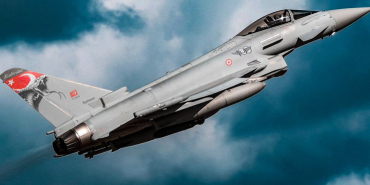
The F-22 Raptor is renowned for its high technology and superior maneuverability, positioning it at the pinnacle of air superiority. However, the aircraft has faced challenges that have occasionally marred its “invincible” reputation. Notably, simulated dogfights against “non-stealth” platforms have sometimes resulted in significant losses for the F-22. Exercises about a decade ago involving German Eurofighter Typhoons and French Rafale fighter jets sparked debates about the aircraft’s capabilities.
Encounter with the Eurofighter Typhoon
In 2012, during the Red Flag air combat exercises over Alaska, close-range Basic Fighter Maneuvers (BFM) were conducted between F-22 Raptors and Eurofighter Typhoons from the German Luftwaffe’s 74th Tactical Air Force Wing. During these dogfights, German pilots took the simulations seriously and recorded hypothetical kills against the F-22s. After the exercises, German pilots boasted about their victories over the F-22s, with one pilot famously saying they “ate Raptor salad for lunch,” which gained significant media attention. Experts suggested that in within visual range (WVR) combat scenarios, the Eurofighter Typhoon, especially when flying without external fuel tanks, had advantages over the F-22. German air officer Marc Grune highlighted that the Eurofighter’s aggressive maneuverability surprised F-22 pilots, creating unexpected parity in close combat situations.
Encounter with the Rafale
Another aircraft that gained attention for outperforming the F-22 was the French Rafale. In a 2009 training exercise in the United Arab Emirates (UAE), the Rafale competed against UAE Mirages, British Typhoon jets, and a squadron of F-22 Raptors from the U.S. Air Force’s 1st Fighter Wing. After the exercise, the French Ministry of Defense released footage from the Rafale’s forward-looking camera showing a Raptor in a disadvantaged position against the Rafale. While the U.S. denied that any F-22 was defeated by the Rafale, they acknowledged that one F-22 had been “shot down” by a UAE Mirage during the exercise. Analysts noted that the French pilot pushed the Rafale to its limits, reaching 9G during the dogfight and demonstrating impressive maneuverability.
Struggle for Air Superiority in the Pacific
The deployment of F-22 Raptors to Japan’s Kadena Air Base is seen as a reflection of the growing geopolitical tensions in the Pacific. China’s increased military presence in the region and its territorial claims in the South China Sea have intensified U.S. efforts to maintain air superiority alongside its allies. Stationing F-22s at Kadena Air Base is viewed as a move to bolster U.S. deterrence in the region.
Deterrent Force in the Region
This deployment is also part of the U.S.’s broader strategy to strengthen military cooperation with its allies and ensure stability in the region. With their advanced radar systems and high maneuverability, F-22 Raptors are considered a crucial deterrent against potential threats in the Pacific.
© www.aerohaber.com | www.tr.aerohaber.com
Note: Aviation news on our news site cannot be used without citing the source