


For an airline operation to run smoothly, many units play an important role—from pilots and technicians to cabin crew and ground operations officers. However, there is a professional group with a critical role in aviation whose awareness among the public is quite low: flight dispatchers.
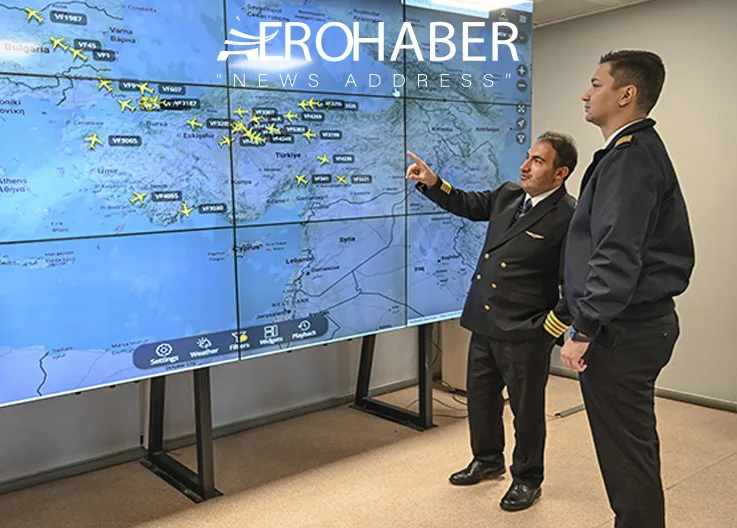
Dispatchers manage the entire process from the start of the flight to landing, conveying flight information to all relevant units; and in emergencies such as sabotage, hijacking, or accidents, they carry out critical communication and guidance. Their signatures are found on every step, from aircraft routing and meteorological data to fuel planning and cost analysis.
“We plan the flight before the pilots arrive at the aircraft”
AJet Flight Operations Manager Orhan Atmaca explained the importance of the profession to an AA correspondent, drawing on his 23 years of experience. Atmaca noted that the captains arrive with a ready flight plan thanks to the flight packages they prepare, saying:
“Before the captains come to the aircraft, we compile all airport information, weather conditions, and passenger and weight data, and we prepare the flight plan. We also monitor the operation through the tracking system until the aircraft lands.”
Atmaca cited an example of a Berlin flight requiring turbulence forecasting, where they optimised the aircraft’s route and altitude to prevent passengers from being affected by adverse weather conditions.
“Delays are delays made for safety”
Speaking about delays, which passengers often react to, Atmaca emphasised that all such delays are safety-oriented:
“If the landing airport’s weather conditions, visibility level, or snowfall are not favourable, we postpone the flight. Otherwise, the aircraft could face the risk of an accident.”
He added that in extremely hot weather, weight restrictions may be applied, which in some cases requires offloading baggage.
“The dispatcher and operations control unit are the kitchen of aviation”
Noting that the profession is not well known, Atmaca described dispatching as follows:
“We are the headquarters of an airline. We are the brain and heart of aviation operations. We are the eyes and ears of our captains while they are in the air.”
He highlighted that they remain on duty to ensure flights continue safely even during extraordinary situations such as earthquakes, wars, or coup attempts.
“I further developed my passion for aviation through dispatching”
Doğuş Suray Kara, AJet Operational Safety and Efficiency Leader and a former cabin crew member, described her career journey with these words:
“After working as cabin crew, I discovered dispatching. I wanted to get right into the heart of the job. I nourished my passion for aviation even more with this profession.”
Kara stated that they optimise routes for flight safety in risky airspaces such as the Middle East, adding that passengers may not notice these route changes, but they are planned for safety.
She also said that dispatching is often confused with cockpit and tower duties and noted that the profession offers significant career opportunities for university graduates.
Dispatchers: The unseen yet indispensable force of aviation
Flight dispatchers virtually experience every flight step by step, analysing all risks in advance, providing cost optimisation to save airlines money, and ensuring that flights take place safely and efficiently under all conditions.
This profession group, which is critically important for the sustainability of civil aviation operations, is recognised as the “unseen heroes” in international civil aviation.