


It is rare for a carrier to abandon a route before the first flight, but it does happen. According to the latest schedule submission to Cirium Diio, Southwest Airlines has removed all flights from Harry Reid International Airport (LAS), serving Las Vegas, to Norman Y. Mineta San José International Airport (SJO), Costa Rica.
This was going to be a notable addition for various reasons. For example, it was to become the hybrid operator’s new longest international service by both distance and time; it was to be the airport pair’s first nonstop service; it was to be LAS’ third-largest unserved market in Latin America, after São Paulo and Buenos Aires; and it was to be Southwest’s only overnight international operation.
Cirium data shows that Southwest was to commence this route on November 1, which was pushed back from October 1. Covering 2,297 nautical miles (4,254 km) each way, the maximum block time for the first few months was going to be just shy of six-and-a-half hours.
With an 11:55 PM departure from Nevada, it was to be the carrier’s sole international service with overnight flights. The full schedule is shown below, although the inbound timings to LAS were to vary somewhat. Like so many of Southwest’s routes, one specific aircraft would have operated outbound, while another frame would have flown inbound. Flowing aircraft around the system is commonplace for the airline.
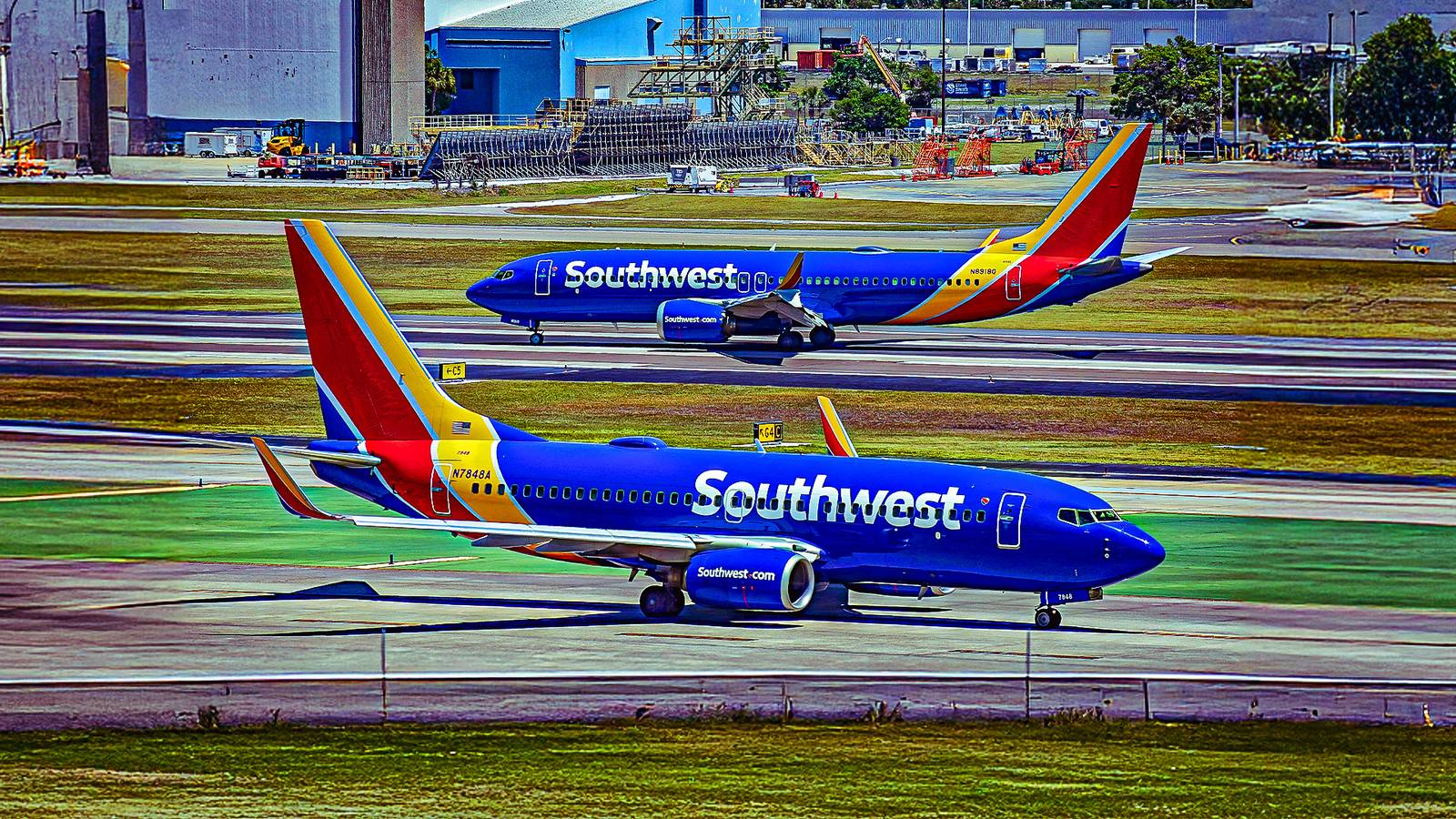
LAS-SJO was to be flown using the 137-seat Boeing 737-700, perhaps given the high frequency and being a brand-new market. Perhaps the carrier wanted to develop demand and loads before increasing the aircraft size. However, rotating the specific aircraft in SJO means that the larger, 175-seat 737 MAX 8, which is much more fuel-efficient and with a lower cost per available seat mile, was to operate all but one departure from Central America back to LAS. It is fairly uncommon for this imbalance to occur.
The latest schedule update shows that all flights have been removed. It is unclear if this is a permanent change or if the route has simply been postponed again and will commence later. The airline has been contacted for comment.
Southwest has flown internationally since July 1, 2014. The carrier’s debut in Costa Rica took place the following March, with flights to SJO. Initial routes were from Baltimore/Washington International Thurgood Marshall Airport (BWI), quickly followed by Houston George Bush Intercontinental Airport (HOU). Flights from Fort Lauderdale-Hollywood International Airport (FLL) materialized in 2017, followed by Denver International Airport (DEN) in 2023, Orlando International Airport (MCO) in 2024, and Nashville International Airport (BNA) in 2026. FLL was dropped in 2020.
Service to Liberia, which is the gateway to beaches, national parks, and other outdoor pursuits, began in November 2015. HOU and BWI were the first two markets, complemented by Los Angeles International Airport (LAX) in 2017 and DEN in 2021. BNA gets Liberia flights next February. LAX flights ended in 2017.
Between March 2015 and April 2026, the US Department of Transportation shows that Southwest has transported 2.7 million passengers to/from Costa Rica. SJO had 1.6 million passengers and Liberia had 1.1 million. SJO flights filled slightly more seats (83.4%) than those to Liberia (80.1%), but this says nothing of fares and yields.
All of them were served before, but they’ll now have five daily flights between them. See them all here!
Between August 2026 and March 2027, Southwest plans flights to 14 airports beyond the US border. They are Aruba, Belize City, Cancun, Grand Cayman, Havana, Liberia, Los Cabos, Montego Bay, Nassau, Providenciales, Puerto Vallarta, Punta Cana, St. Maarten, and SJO. Predictably, Cancun will be the most-served airport for flights.
The airline plans an average of 43 international departures in this period. Compared to August 2025 to March 2026, activity has risen by a considerable 14%. The big percentage growth is influenced by this market being only a tiny part of Southwest’s total operation. The airline’s daily departures will vary dramatically, from from 20 to 102 — exceeding the 100 milestone for the first time.
Orijinal Haberi Görüntüle