

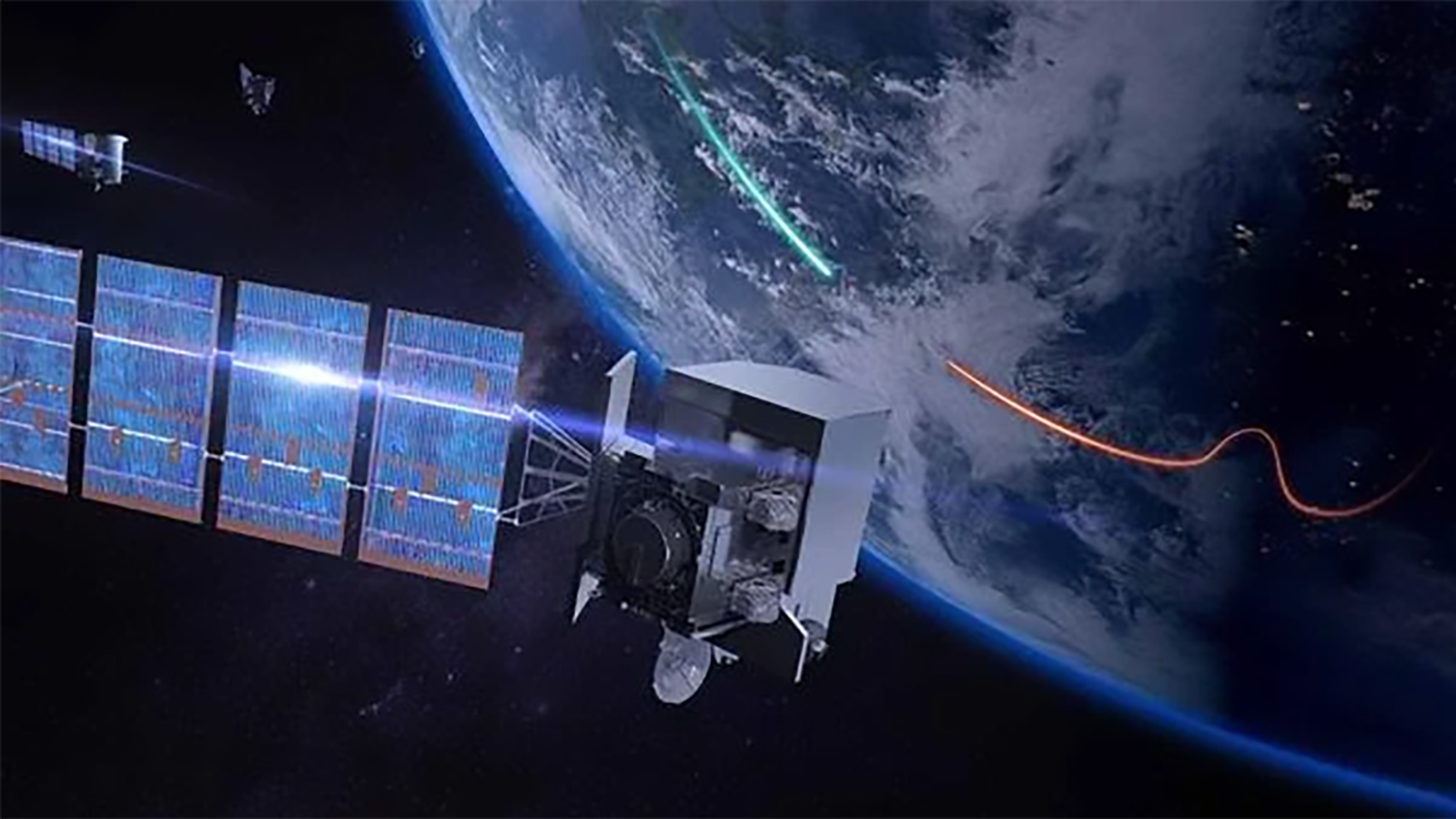


WASHINGTON —The Space Development Agency has awarded L3Harris Technologies and Sierra Space contracts, worth a total of $1.75 billion, to develop 36 satellites for missile warning, tracking, and targeting in support of the Pentagon’s Golden Dome missile shield.
The new birds, dubbed “Accelerated Missile Defense Tranche 3 (AMDT3) space vehicles (SVs),” are to be ready for launch in 2028 — which is when President Donald Trump has mandated Golden Dome to be operational. The previous SDA Tranche 3 Tracking Layer contracts, awarded last December to L3Harris, Lockheed Martin, Northrop Grumman and Rocket Lab and worth up to $3.5 billion for 72 satellites, are not slated to launch until 2029.
“[T]he the good piece of this is that, I think, we can actually now go on the record and talk about … that it’s helping with the Golden Dome architecture, which is new and finally flowing some money,” Jeff Schrader, chief financial officer at Colorado-based startup Sierra Space, told Breaking Defense.
Under its contract worth up to about $955 million, L3Harris is to provide “18 Hypersonic and Ballistic Tracking Space Sensor (HBTSS)-like missile defense variant SVs across two orbital planes,” according to SDA’s announcement on Monday.
Sierra Space was awarded a contract worth up to $798 million to provide 18 “missile warning/missile tracking variant SVs across two orbital planes.”
Gurpartap “GP” Sandhoo, SDA director and Space Force portfolio acquisition executive for missile warning and tracking, said in a statement, “With these awards, SDA is accelerating the deployment of the Tracking Layer to provide the homeland, our deployed forces, and allies with global, persistent indications, detection, identification warning, tracking, and defense against advanced and evolving missile threats.”
SDA’s missile warning/missile tracking satellites carry wide field-of-view infrared cameras that can spot missiles when they launch and follow them in flight over a large volume of space. Satellites designated missile defense variants carry more precise medium field-of-view cameras, which cover a smaller area, but can generate data good enough for providing interceptors with targeting coordinates.
ASELSAN at SAHA 2026: Introducing next-generation multi-domain defense systems
Unveiled at SAHA 2026, ASELSAN’s latest portfolio reflects a layered and integrated defense architecture, bringing together electronic warfare, counter-UAV, airborne and naval capabilities within a unified operational framework.
Josh Lovejoy, general manager for proliferated missile defense at L3Harris, explained that the “missile warning, missile tracking, missile defense” monikers denote a “spectrum of technical requirements”: first “seeing” the incoming missile; second, generating its position, velocity and trajectory; and lastly producing “actionable information” with “high confidence” that the “spatial and the temporal resolution” of the data is up to “fire control quality” that can enable a hit.
Both L3Harris and Sierra Space, along with Lockheed Martin, also are building SDA’s previous generation Tracking Layer Tranche 2 satellites under a January 2024 contract with a total value $2.5 billion. Each contractor is slated to develop 18 birds (16 for missile warning/tracking, two for missile defense) for launch no later than April 2027.
L3Harris, which originally developed the HBTSS for the Missile Defense Agency, has invested its own money for “upgrades and technology enhancements” to the initial sensor design, Lovejoy told Breaking Defense, but would not go into details about the capabilities.
Schrader said that Sierra Space has invested $1.5 billion on its missile defense capabilities prior to the new SDA contract award.
“We’ve invested a significant amount of of our capital in in our last several series funding raises on building out the infrastructure, being able to scale to these larger constellations,” he said.
At the same time, Schrader added, Sierra Space has been working with its subcontractor Leidos “developing some really new capabilities for not only missile warning/missile tracking, but also, holistically, missile defense” based on the state-of-the-art “8K [8,000 by 8,000 pixels] focal plane arrays” developed for the Tranche 2 sensor payload.
“So, instead of doing a full new architecture with new busses, with new with new payloads, new everything … really working with our focal plane provider, our partners with Leidos and utilizing software to provide fire control quality for tracking,” he said.
Orijinal Haberi Görüntüle