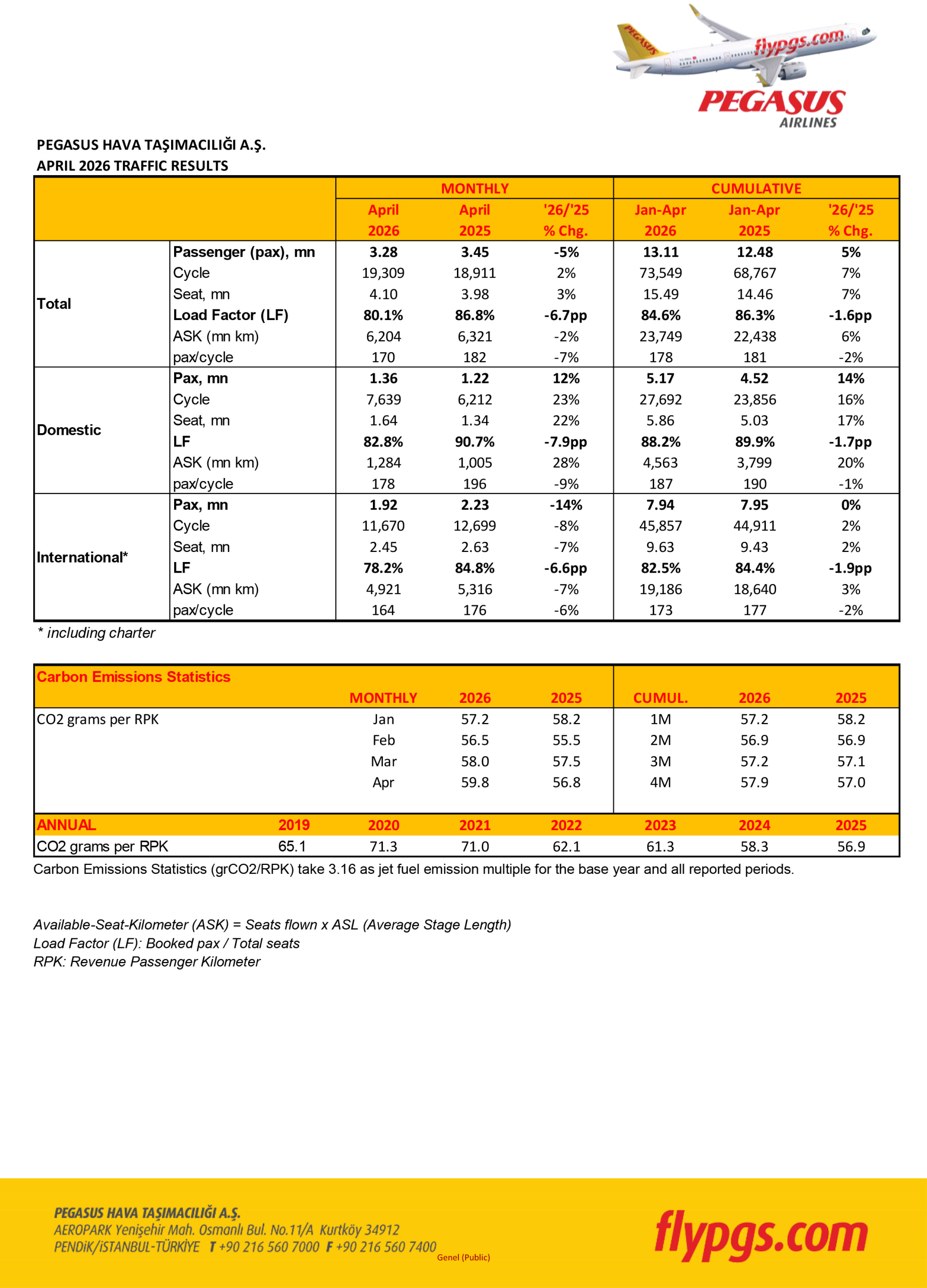




Pegasus’ April 2026 traffic data showed a monthly decline in passenger numbers, strong growth in domestic routes, and a downturn in international operations. While the load factor weakened, carbon emissions continued their long-term improvement trend.
Pegasus Airlines’ April 2026 traffic results reveal a picture in which the company increased capacity, but experienced a noticeable decline in passenger load factors. The divergence between domestic and international routes also indicates that operational dynamics are moving in different directions.
Passenger numbers declined, but the overall year remained in positive territory
In April, total passenger numbers fell to 3.28 million, marking a 5 percent decline compared to the same period last year. However, during the January–April period, total passenger traffic increased by 5 percent to 13.11 million.
This divergence shows that monthly fluctuations have not disrupted the annual growth trend.

Domestic market strong, international market under pressure
The picture is stronger in domestic operations. In April, domestic passenger traffic increased by 12 percent, while growth reached 14 percent in the first four months of the year. The increase in landings also indicates that network expansion in domestic operations is continuing.
International operations, however, moved in the opposite direction. In April, passenger numbers declined by 14 percent, while ASK (available seat kilometres) decreased by 7 percent. This trend points to a period in which international capacity is being rebalanced.
Decline in load factor: capacity growth did not match demand at the same pace
In April, the total load factor fell to 80.1 percent. In the same period last year, this figure stood at 86.8 percent. Domestic routes recorded 82.8 percent, while international routes stood at 78.2 percent.
Despite the increase in seat capacity, passenger demand did not grow at the same pace, creating downward pressure on load factors.
ASK grows, while efficiency remains more cautious
In April, total ASK declined by 2 percent, while the first four months of the year recorded a 6 percent increase. Domestic ASK posted a strong 28 percent rise, whereas international ASK fell by 7 percent.
Carbon emissions: annual improvement continues
Carbon emission data (CO2 gram/RPK) continues to maintain a long-term downward trend. The figure, which stood at 65.1 in 2019, declined to 56.9 by 2025.
In the first four months of 2026, emissions remained broadly stable in the 56.9–57.9 range on a monthly basis. In April, emission intensity rose to 59.8, marking the highest monthly level of the year so far.
While this fluctuation shows that short-term operational changes can affect emissions performance, the long-term downward trend remains intact.
Operational balance: growth and efficiency are not moving in parallel
The data reveals a period in which the company is expanding capacity, but demand is not matching this growth equally across all regions. While domestic operations continue to show stronger growth, the impact of restructuring is being felt in international markets.
The decline in load factors and pressure on unit efficiency indicate that capacity management will become even more critical in the upcoming period.