
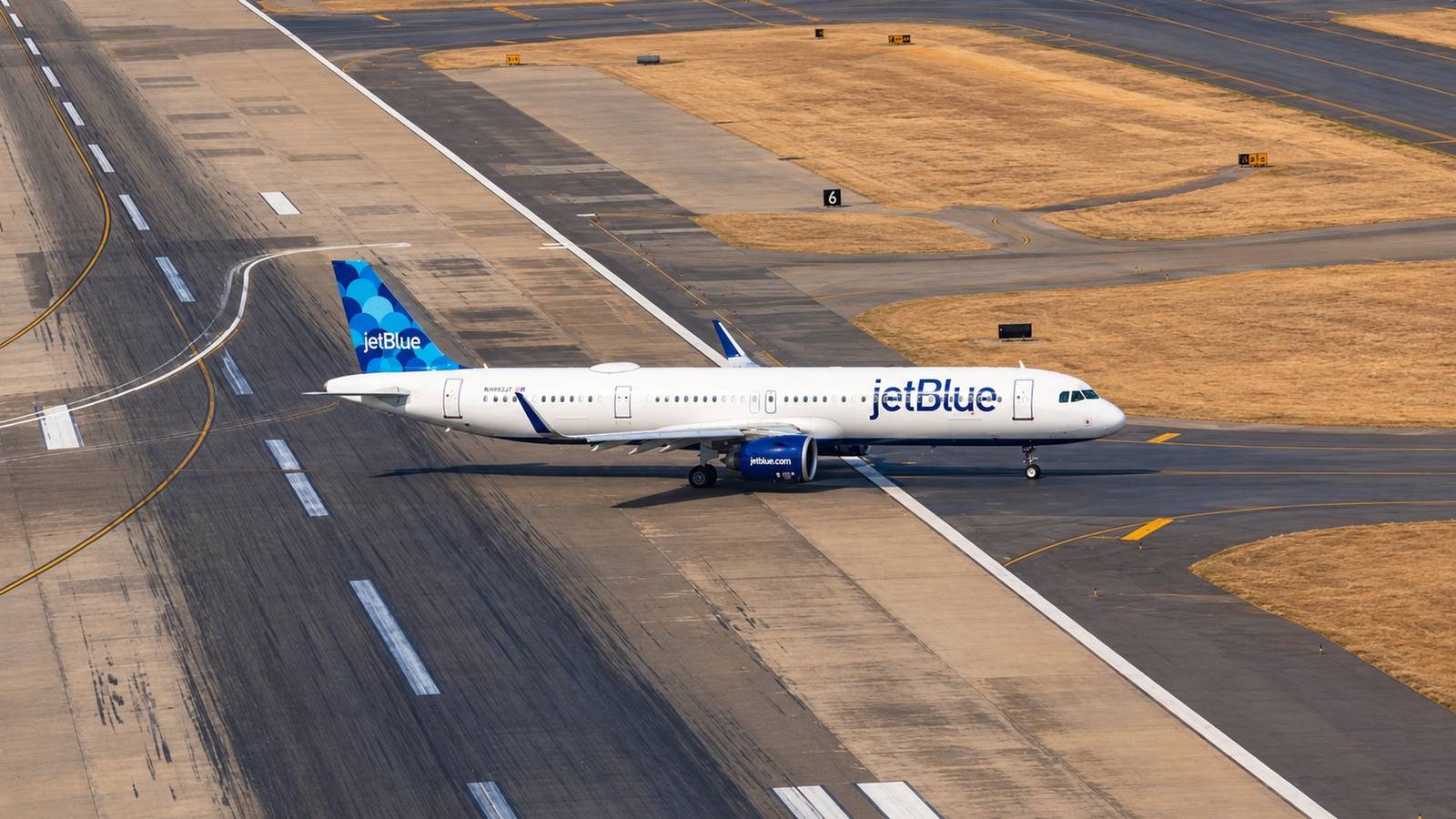


A JetBlue pilot reported hitting a drone while approaching New York JFK Airport (JFK) earlier this morning, prompting an investigation by the Federal Aviation Administration (FAA) into another apparent drone encounter near one of the country’s busiest airports.
The crew of JetBlue Flight 948, an Airbus A321 arriving from Las Vegas, told air traffic control that the aircraft had collided with a drone while descending toward JFK at around 3,000 feet. The flight continued safely to the airport, landed without assistance, and passengers deplaned normally. However, the report was serious enough for JetBlue to remove the aircraft from service for inspection.
The airline later said it found no damage or evidence of a collision, making the case an important reminder that pilot reports of drone strikes often require careful follow-up before the details are confirmed.
JetBlue Flight 948 Lands Safely After Reported Drone Strike
JetBlue Flight 948 was nearing the end of its overnight journey from Harry Reid International Airport (LAS) in Las Vegas when the crew reported the apparent drone encounter on approach to JFK. According to air traffic control audio, the pilot told controllers, “We collided with a drone back there in the turn,” adding that the object appeared to strike the aircraft above the cockpit. The incident was reported at around 7:15 AM on Monday as the aircraft was descending through approximately 3,000 feet.
Despite the report, the crew did not request emergency assistance and continued the approach into JFK. The aircraft landed safely, and JetBlue said passengers deplaned normally after arrival. The FAA confirmed that it is investigating the report, while JetBlue said the aircraft was taken out of service for inspection, which found no visible signs of damage. JetBlue said the following later in the day:
“The flight landed without incident, customers deplaned normally, and the plane was removed from service for a post-flight inspection, which found no damage or evidence of a collision.”
Even so, the event remains notable because the pilots firmly believed the aircraft had struck a drone at an altitude and location where unauthorized drone activity could pose a serious risk to commercial aircraft. The FAA investigation will now need to determine what, if anything, was in the aircraft’s path during the approach.
The basic safety issue is that a drone is not a bird. Birds are largely soft tissue, while even small consumer drones can contain metal, hard plastics, electric motors, cameras, circuit boards, and dense lithium-ion batteries. That makes the damage pattern potentially very different from the bird strikes that commercial aircraft are designed to withstand.
The greatest risks depend on the drone’s size and where it might hit the aircraft. A small drone striking a reinforced panel might only trigger a maintenance inspection. A larger or heavier drone hitting a windshield, entering an engine, striking a sensor, or damaging a flight control surface could create a much more serious situation, particularly during takeoff or landing when pilots have less time and altitude to manage a problem.
A drone’s rigid components could crack or damage cockpit glazing, creating a serious distraction or injury risk.
Motors, batteries, and hard components could damage fan blades or internal engine parts differently from bird material.
A strike on a slat, flap, stabilizer, or leading edge could require immediate inspection and potentially affect aerodynamics.
Damage to sensors, antennas, pitot/static systems, or control surfaces could complicate aircraft handling.
Lithium-ion batteries in drones introduce a fire or thermal event risk not normally associated with bird strikes.
Even without damage, a drone encounter can force crews and controllers to react during a critical phase of flight.
FAA guidance limits drone operations to below 400 feet in most locations, and flights in controlled airspace around airports usually require FAA authorization. The FAA also says it receives more than 100 drone-sighting reports near airports each month, and warns that unauthorized drone operations around aircraft, helicopters, and airports are dangerous and illegal.
The military dimension has expanded the concern considerably in recent years. Cheap drones have become heavily used and highly destructive weapons in Ukraine and the Middle East in recent years. It is not a stretch to imagine the technology being used by terrorists to attack commercial aircraft. While there is no indication that the event in New York was malicious, a suspected drone at around 3,000 feet in a busy commercial arrival corridor is precisely the kind of scenario that aviation authorities worry about.
Another aircraft reported seeing the drone at around 2,000 feet of altitude.
For now, the answer is still uncertain. The pilots were very clear that they had “collided with a drone,” and where it had struck the aircraft. But given that they were on the approach, the speed of the aircraft, and the fact that the pilots would have been operating with a high workload, they are unlikely to have a detailed description of what they hit. The lack of damage to the aircraft also raises more questions than it answers.
That uncertainty matters, because there have been multiple claims of drone strikes in the past that have not been proven out. A similar case in April shows why early reports need caution. A United Airlines pilot initially reported a possible drone strike while approaching San Diego International Airport (SAN), but United later said there was no evidence of impact, and the FAA later determined the drone passed about 1,000 feet below the aircraft rather than hitting it.
Confirmed drone strikes involving manned aircraft in the United States have been extremely rare, and the best-documented cases have overwhelmingly involved Helicopters rather than commercial airliners. Indeed, if the investigation does conclude that it was a drone strike, it would very likely be the first confirmed incident on a commercial aircraft.
Collided with a privately operated DJI Phantom 4 at about 300 ft MSL; helicopter sustained minor damage.
Crew reported impact with an unknown object near Los Angeles City Hall; investigators concluded it most likely struck a drone.
DJI Mavic 2 Zoom collided with a helicopter during filming of an off-road race.
DJI Mavic 2 impacted the helicopter’s main rotor, causing substantial rotor-blade damage.
Crew reported a possible drone strike on approach; aircraft landed safely, and no damage was found.
The FAA is investigating the incident, but the absence of visible damage to the aircraft may limit the physical evidence investigators can examine. If it were a drone, however, the incident would mark a concerning new chapter for commercial aviation.
Airline crews are already trained for bird strikes, engine failures, rejected takeoffs, and unstable approaches. A small, hard-to-see drone at 3,000 feet adds a different kind of threat: one that is cheap, mobile, difficult to detect, and potentially capable of appearing in precisely the airspace where a commercial aircraft has the least room to maneuver.
Orijinal Haberi Görüntüle