
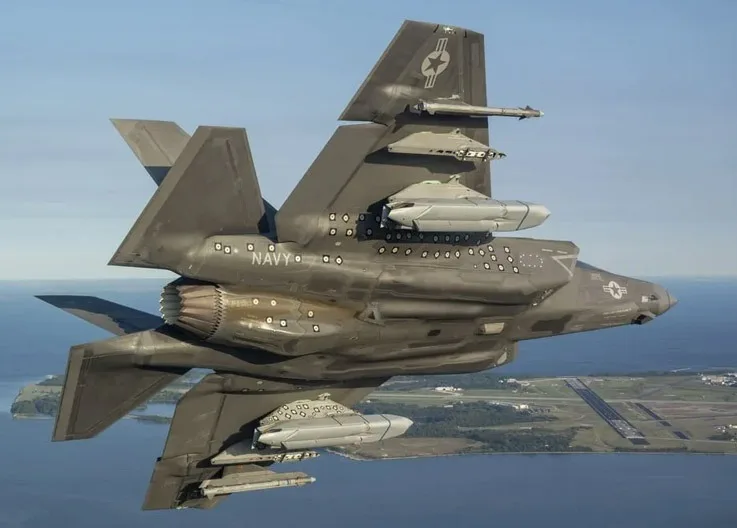


The Pentagon has publicly shared the first image of the F-35 stealth fighter jet equipped with the AGM-158C Long-Range Anti-Ship Missile (LRASM). This development is seen as a significant step in boosting the U.S. Navy’s capabilities, expected to provide strategic superiority, particularly in a potential South China Sea conflict against China.
The photograph in question is from a test flight conducted on September 10 at NAS Patuxent River Base in Maryland. The image shows an F-35C, capable of landing on U.S. Navy aircraft carriers, carrying two LRASM missiles under its wings. This advancement adds enhanced anti-ship strike capabilities to the already powerful F-35.
In a statement by the Pentagon, it was mentioned, “As part of ongoing integration efforts, the Pax River F-35 Integrated Test Team successfully conducted test flights with AGM-158C LRASM missiles loaded onto the F-35’s external weapon stations. This missile will provide long-range and advanced anti-ship capabilities against high-threat maritime targets.”
F-35 and LRASM: New Capabilities Against High Threats
A derivative of the AGM-158 Joint Air-to-Surface Standoff Missile (JASSM), the LRASM is equipped with an advanced GPS-aided Inertial Navigation System (INS) and an Electronic Support Measures (ESM) package. This technological superiority allows the missile to alter its course before reaching the target and respond to sudden air defense threats.
As the missile approaches its target, it uses an imaging infrared (IIR) seeker system to classify the target and execute a highly precise strike. These features enhance the F-35’s effectiveness against naval platforms, providing the U.S. airpower with a strategic advantage, especially against high-threat naval forces like those of China.