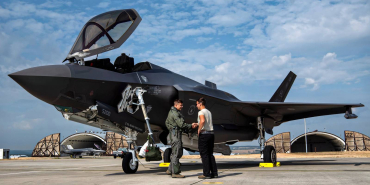

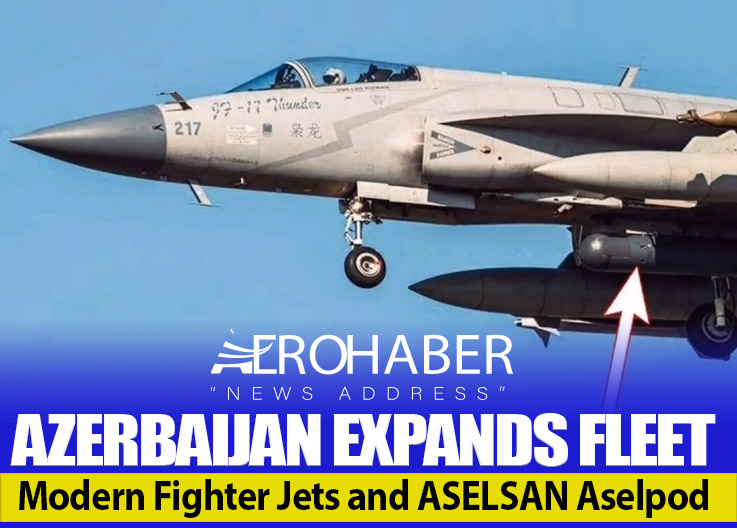


Azerbaijan plans to purchase approximately 40 JF-17 Thunder Block III fighter jets produced jointly by China and Pakistan. The aircraft will use the Aselpod targeting system developed by the Turkish defence company ASELSAN.
Azerbaijan’s JF-17 Block III Decision: To Be Equipped with Turkish Aselpod
A new defence move that could affect the military balance in the Caucasus is on the agenda. Azerbaijan plans to purchase approximately 40 units of the Block III model, the most advanced version of the JF-17 Thunder fighter jets developed through a partnership between China and Pakistan.
Within the scope of the plan, the aircraft are expected to be equipped with the Aselpod targeting pod developed by the Turkish defence industry company ASELSAN.
Search for a modern and cost-effective fighter jet
The JF-17 Thunder, which made its first flight in 2003, reached operational capability in 2010 and became a cost-effective fighter jet alternative for many countries.
Estimated unit cost of the aircraft:
- 25–30 million dollars
- modern avionics architecture
- multi-role mission capability
This price-performance balance creates an attractive option for countries that need rapid modernisation.
It is stated that Azerbaijan is also aiming to build a modern yet financially sustainable air power for this reason.
Turkish Aselpod system to be integrated
Another notable element in the planned agreement is the Aselpod electro-optical targeting pod developed by ASELSAN.
The system, which weighs approximately 240 kg, has the following features:
- high-resolution infrared camera
- day TV sensor
- laser designator and rangefinder
- multi-target tracking
- stabilised inertial navigation system
Thanks to this sensor package, the aircraft are said to be able to detect and designate targets with high precision during air-to-ground attacks.
Multi-platform use provides advantages
The fact that Aselpod has previously been used on different platforms is considered a significant advantage for Azerbaijan.
The system has already been tested or used on the following platforms:
- F-16 Fighting Falcon
- JF-17 Thunder (previous variants)
- F-4E Terminator 2020
- CASA CN-235
This multi-platform integration experience reduces technical risk for new users and shortens the time required for entry into service.
Regional competition played a role
Azerbaijan’s plans to modernise its air power have accelerated in recent years. One of the important reasons for this is the change in regional military balances.
In particular, Armenia’s purchase of Sukhoi Su-30SM fighter jets in 2019 increased air power competition in the Caucasus.
A significant portion of the Azerbaijan Air Force’s strike missions still relies on Sukhoi Su-25 aircraft. Therefore, the need to transition to a modern platform is on the agenda.
Alternative options were also evaluated
The Baku administration had previously evaluated Leonardo M-346 training and light attack aircraft produced in Italy.
After demonstration flights carried out in 2017:
- an order for 10 aircraft
- an option for 15 aircraft
- a plan including these elements had been studied. However, this project did not progress due to cost and operational evaluations.
Significant fleet expansion with JF-17 Block III
If Azerbaijan places an order for approximately 40 JF-17 Thunder Block III aircraft, this will mean a significant expansion in the country’s fighter jet fleet.
The Block III version includes significant technological improvements compared to previous versions, such as:
- advanced AESA radar
- modern electronic warfare systems
- long-range air-to-air missiles