
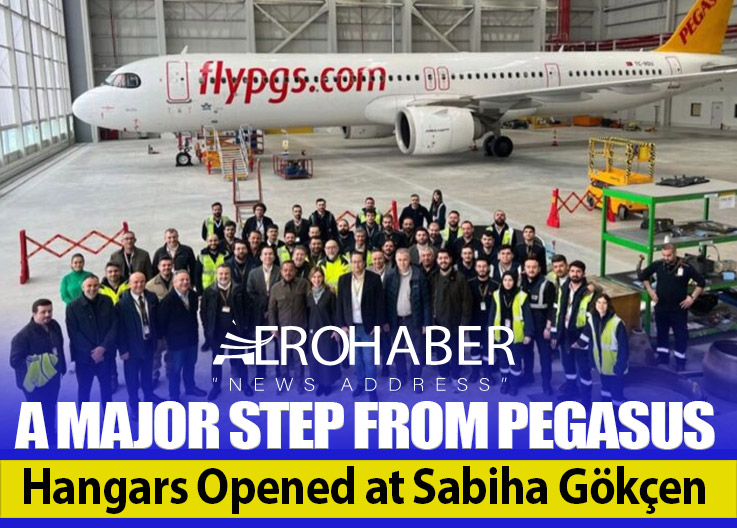


Pegasus Airlines has expanded its technical capacity and capabilities by opening the first phase of its aircraft maintenance center investment at Sabiha Gökçen Airport. The hangars, which provide simultaneous maintenance capability for five narrow-body aircraft in the first phase, will significantly enhance the company’s operational strength with infrastructure focused on digitalisation, efficiency, and sustainability.
Pegasus Airlines has significantly increased its technical maintenance capacity and capabilities by commissioning the first phase of its new aircraft maintenance center consisting of narrow-body aircraft maintenance hangars at Sabiha Gökçen Airport. With the hangar investment, initially realised with an investment of 40 million dollars, Pegasus aims to strengthen operational efficiency by optimising time and resources in maintenance processes and reducing aircraft ground time caused by maintenance.
End-to-end maintenance and technical operations infrastructure
The project, launched on 29 January 2025, was completed within one year and became operational with its first phase. In the first phase, two maintenance hangars capable of line and base maintenance for five narrow-body aircraft simultaneously, along with one paint hangar, were commissioned. With the second phase to be completed in the last quarter of 2026, another hangar capable of base maintenance for five additional narrow-body aircraft will enter service. In the third phase, this hangar will be expanded to accommodate ten narrow-body aircraft, completing the aircraft maintenance center investment.
These first-phase hangars, which will bring line and base maintenance activities under one roof, are designed to support a wide range of operations, from daily line maintenance supporting flight operations to engine and landing gear replacements, avionics and structural modifications, base maintenance applications, full aircraft painting processes, exterior livery design and coating applications, component maintenance, and training activities.
Güliz Öztürk: “The new hangar investment is a strategic step for faster and more optimised operations”
Pegasus Airlines CEO Güliz Öztürk commented on the new investment as follows:
“Every investment we make in technical infrastructure moves our operational strength one step further. Our aircraft maintenance center investment at Sabiha Gökçen represents a strategic milestone in Pegasus’ sustainable growth journey. Our new hangars will enable us to manage the maintenance needs of our growing fleet more effectively while accelerating our digitalisation and efficiency-focused transformation. By managing aircraft maintenance processes faster and in a more optimised manner, we aim to provide our guests with an uninterrupted flight experience.”
Pegasus increases maintenance and operational strength with first-phase hangars
These hangars, capable of serving five narrow-body aircraft simultaneously, have infrastructure suitable for all narrow-body aircraft types with authorisation for Boeing 737 NG and Airbus A320/A321 family CEO and NEO models. In addition to two hangars where maintenance and modification activities will be carried out, the facility also includes a separate hangar specifically built and equipped for aircraft painting.
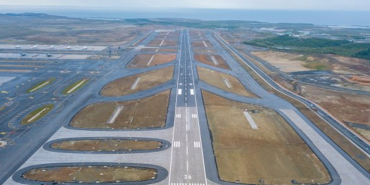
Located in a total enclosed area of 18,000 square metres and supported by a 25,000 square metre apron, the structure is positioned at a strategic transit point between the two runways of Sabiha Gökçen Airport. The first-phase hangars, realised with an investment of approximately 40 million dollars, will create additional employment for around 200 people alongside increased technical capacity.
The facility will primarily serve Pegasus’ growing fleet; in the future, depending on capacity availability, aircraft belonging to other airlines may also be accepted.
Digitalisation and sustainability together in the new hangar…
The hangar also forms an important part of Pegasus’ digital maintenance and sustainability vision. Processes advance faster and more efficiently through applications such as paperless maintenance processes, digital warehouse and tool management systems, unmanned Personal Protective Equipment dispensers, and AI-supported occupational health solutions. Preventive maintenance activities and data analytics systems enable maintenance needs to be predicted in advance, supporting uninterrupted operations. In terms of sustainability, infrastructure focusing on energy efficiency and waste management was preferred during hangar construction.
About Pegasus Airlines:
Pegasus entered the aviation sector in 1990 and adopted the low-cost business model after being acquired by ESAS Holding in 2005. As Türkiye’s leading low-cost airline, Pegasus believes that air travel is everyone’s right and offers guests affordable travel opportunities with young aircraft through its low-cost airline model. Operating with the vision of “Türkiye’s Digital Airline” since 2018, Pegasus transports guests to a total of 158 destinations in 55 countries, including 39 domestic and 119 international routes, and operates connecting flights between Türkiye and Europe, the Middle East, Central Asia, and North Africa via Istanbul Sabiha Gökçen. With its guest-focused approach, Pegasus offers digital technologies and unique innovations that make travel experiences easier.