



A Royal Jordanian crew member has died, and several others have been injured, after a bus carrying airline crew was involved in a deadly crash in New York City. The incident occurred after the crew had arrived at New York JFK Airport (JFK) and was being transported to its overnight accommodation, turning what should have been the final stage of a long-haul duty day into a tragedy.
Royal Jordanian confirmed that the bus was carrying 15 crew members, including two Thai flight attendants, from JFK to their accommodation when the collision occurred in the early hours of Tuesday, June 30. The airline said one crew member died, while the remaining injured crew members were in stable condition and receiving medical care.
Royal Jordanian Confirms Fatal Crew Bus Collision In New York
Royal Jordanian said the accident involved the crew of Flight RJ261, a nearly 11-hour transatlantic flight that landed shortly after 4:00 PM local time. The airline issued a statement from Amman confirming the collision and saying that the bus was carrying 15 of its crew members at the time of the accident. It also expressed its grief at the accident:
“The airline expresses its profound sorrow over this unfortunate incident, offering its condolences and sympathies to the family of the deceased, and wishing the injured a speedy recovery.”
Local reports described a wider multi-vehicle crash on the Long Island Expressway in Queens late on Monday night. People reported that the crash happened at around 11:45 PM near Greenpoint Avenue, when a bus struck another vehicle before flipping over the central median and hitting further vehicles in the oncoming lane. The broader crash left two people dead, including the driver of the bus, and more than two dozen more were injured and transported to Bellevue Hospital, NewYork-Presbyterian Queens and Elmhurst Hospital Center to be evaluated for injuries.
The airline did not identify the deceased crew member in its initial statement, and no further details were immediately provided about the individual crew members’ injuries. Royal Jordanian said it was closely following developments with the relevant authorities and would continue to monitor the condition of the injured crew members while providing support.
New York Sits At The Heart Of Royal Jordanian’s North America Network
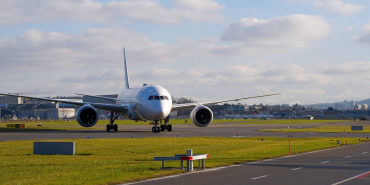
The incident occurred away from the aircraft, but it still affected one of Royal Jordanian’s most important long-haul operations. The airline operates daily to JFK using a Boeing 787-8, and more recently, with a Boeing 787-9 on occasion, as the first of its order for six of the type was delivered earlier this year.
JFK was Royal Jordanian’s first North American destination, launched in 1977 when the airline was still called “Alia,” as a route from Queen Alia International Airport (AMM) in Amman that operated via Amsterdam Schiphol Airport (AMS) using a Boeing 747-200. Since then, the airline has expanded its North American operations to seven destinations, all served with its growing Dreamliner fleet.
Royal Jordanian’s transatlantic network has grown considerably in recent years. As flights resumed after the pandemic, it added Montréal–Trudeau International Airport (YUL), Toronto Pearson International Airport (YYZ), and Detroit Metropolitan Wayne County Airport (DTW) to its schedule in 2022.
By 2025, it had added flights to Washington Dulles International Airport (IAD), connecting the Jordanian and American capitals. Most recently, it added a new 14-hour route to Dallas/Fort Worth International Airport (DFW), where it connects into the largest hub for American Airlines, its oneworld partner.
Its jets are now seen in seven North American cities. Find out all about the new Dallas service here!
Crew Safety Does Not End When The Aircraft Parks
The latest details reported locally add another layer to the tragedy. ABC7NY has reported, citing multiple sources, that the deceased bus driver had seven prior arrests, including for burglary, sexual abuse and forcible touching, and was a registered Level 2 sex offender. The station also reported that he had a valid driver’s license and seven moving violations. The cause of the crash remains under investigation, with the National Transportation Safety Board (NTSB) working with the New York Police Department (NYPD).
These new details do not answer the central investigative questions, and they should not be used to assign blame before authorities complete their work. But they do underline a difficult reality for airline crews: once they leave the aircraft, they can be exposed to risks they did not choose, cannot assess, and cannot easily control. A crew can complete a long-haul flight safely, clear the airport, board a contracted transfer bus, and still be dependent on decisions made by strangers, third-party providers, local roads, and conditions far outside the airline cabin.
That is what makes crew layover safety such an important part of an airline’s duty of care. Aviation history offers stark reminders that crews can face extraordinary dangers far from the flying itself. British Airways Flight 149 landed in Kuwait in 1990, right as Iraq invaded the country, and the passengers and crew were taken hostage as human shields. A Taliban attack on Kabul’s Intercontinental Hotel in 2018 killed multiple members of a Kam Air flight crew. And more recently, American Airlines flight attendant Celinda Levno was attacked and killed on a layover in Denver in January 2025, in an attack that took place away from her assigned hotel.
These examples are very different from the Royal Jordanian bus crash, but together they show why crew safety cannot be measured only by what happens in the air. Even with planning, contracts, procedures, and local partners, crews can still find themselves exposed to unpredictable risks once they step off the aircraft. For airlines, the responsibility to its teams does not end at the arrival gate; it continues until every crew member is safely through the layover and ready to return home.
Orijinal Haberi Görüntüle