
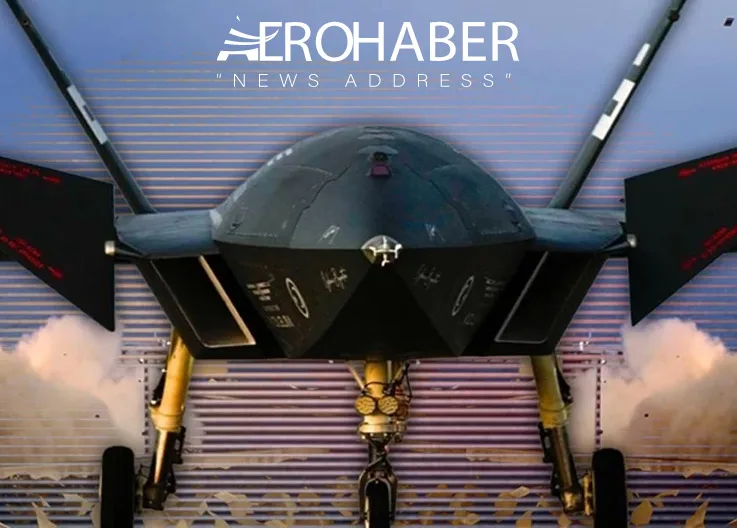


Turkey’s unmanned combat aircraft Bayraktar KIZILELMA has once again achieved a new milestone in a test considered a turning point in national defense technologies. KIZILELMA’s detection and lock-on of an F-16 fighter jet and real-time data transfer to the GÖKDOĞAN air-to-air missile highlighted the critical level of technological capability reached. The test resonated widely in neighboring Greece, making headlines in Athens-based media with comments such as “Turkey’s air power could be at a very different point by 2026.”
F-16 – GÖKDOĞAN – KIZILELMA Triple Synchronization Successfully Executed
Equipped with the MURAD AESA radar developed by ASELSAN, KIZILELMA:
Detected an F-16 from a distance of 30 miles (≈48 km) and locked onto the target,
Transferred position, speed, and targeting data to the GÖKDOĞAN air-to-air missile produced by TÜBİTAK SAGE.
The formation flight of the fifth prototype KIZILELMA, taking off from Çorlu and flying alongside F-16s at 15,000 feet for 1 hour and 45 minutes, further confirmed the test’s success.
This integration has elevated Turkey’s capability to operate manned and unmanned platforms synchronously on the same network.
“2026 Alarm” from Greek Media: Calls for Additional Rafale and F-35 Jets
Greek media reported the development as “Turkey is changing air balance.” Many outlets, including Pentapostagma, highlighted:
Turkey could significantly increase air superiority in the Aegean and Eastern Mediterranean through:
- KIZILELMA, TB-3, ANKA,
- Procurement of F-16 Block 70 Vipers,
- F-35 negotiations,
- Eurofighter Typhoon discussions.
Urgent measures recommended for the Athens administration included:
- Additional Rafale purchases from France should not be delayed,
- At least six second-hand F-35s should be procured from Israel,
- 2026 could be a “difficult year” for Greece.
KIZILELMA: A Strategic Force Multiplier for the Turkish Air Force
Experts state that KIZILELMA, with its low radar visibility, internal weapon stations, AI-based mission algorithms, and advanced sensors, will serve as a critical transitional platform for the Turkish Air Force. Dr. Barın Kayaoğlu from Ankara Social Sciences University emphasizes that KIZILELMA will function as a significant force multiplier until the MMU KAAN enters service.
Baykar’s plan to produce 48 KIZILELMA units by 2026 indicates that this effect will quickly translate into operational capabilities. Collaborations with European firms such as Piaggio Aerospace and Leonardo during the platform’s development further strengthen Turkey’s position in the global defense industry.