


I recently flew on Philippine Airlines’ (PAL) Airbus A350-1000 in economy on an ultra-long-haul flight, and it was pretty good. Now, I’m not usually ‘the trip report guy’, because I primarily fly in economy and I don’t have much to say about my travels. I generally feel like economy is good enough for me, and I can find a way to have fun on almost any flight because I really enjoy flying. This, however, is a unique case because we’re talking about a full-service airline installing ten-abreast economy seats on an A350, and I traveled on this aircraft from New York to Manila.
This is PAL’s longest route, at 7,404 nautical miles (13,712 km), and it’s also the longest nonstop flight that I’ve ever taken by great circle distance. As a whole, while I enjoyed my flight, I definitely wouldn’t recommend it to everyone, and here’s why. Keep in mind, this is my opinion based on my experience compared to other airlines.
Before I get into the flight itself, I want to list out my full trip, because I think it’s important for you guys to understand my frame of reference. Up to this point, the only aircraft type I’ve flown on true ultra-long-haul (ULH) routes was the Boeing 787-9 Dreamliner, and my previous longest flight was from San Francisco to Singapore with United Airlines. I’ve also flown on the Airbus A330-300, A350-900, A380-800, Boeing 767-300ER, 777-200ER, 777-200LR, 777-300ER, and 787-8 on long-haul flights, but not on any 14-to-16 hour flights.
On July 17, I took flight PR127 from John F. Kennedy International Airport (JFK) to Manila Ninoy Aquino International Airport (MNL). After a brief connection, I flew on the carrier’s Airbus A321 with the 2025 cabin on PR507 from Manila to Singapore Changi International Airport. On July 23, I departed Singapore on Qatar Airways flight 945 to Doha Hamad International Airport aboard an Airbus A350-900. After a brief connection, I flew on QR701 from Doha to JFK on the 777-300ER, all in economy.
As you can see, I flew on a 10-abreast A350, a nine-abreast A350, a ten-abreast 777, along with a standard A321. I won’t be discussing those other flights in length, except to compare them to the PAL A350-1000. A350s are usually configured nine-abreast in economy. Before, it was accepted that a ten-abreast layout was too tight for a full-service carrier. But with the new A350 NPS specification comes a wider cabin that Airbus specifically advertises as enabling a more comfortable ten-abreast layout, and PAL is the first full-service airline to implement it.
Airbus advertises that an NPS A350 can be configured ten-abreast with 17-inch-wide seats (43.18 centimeters), or about the same as a ten-abreast 777, but slightly narrower than a nine-abreast 787 by 0.2 inches (0.5 centimeters). Philippine Airlines gives the same measurement. I won’t dispute this figure, and I didn’t measure it personally, but the problem that I immediately noticed upon sitting down is that my shoulder was pressed right up against the sidewall. Admittedly, I have fairly broad shoulders, but this does not happen to me on a nine-abreast A350 to the same extent.
I almost always book window seats, and I try to follow the unofficial rule that the middle seat passenger has the right to both of their armrests, but in this seat, my other shoulder was brushing up against the middle seat (not the armrest, the actual seat). I previously mentioned that I enjoyed this flight, but that was only possible because the middle seat was unoccupied. As such, I was able to make do with the available seat width, but if someone were in the middle seat, I’d have a very different opinion.
The seat is noticeably more cramped than a nine-abreast 787 or even a ten-abreast 777 because the armrests, as shown in my photo above, are the smallest that I’ve ever laid eyes on. In addition, the aisles are quite narrow, and window seat passengers will find themselves pressed up against the sidewall. So while yes, the seat itself is about the same width as you’ll find on newer Boeing widebodies, you will have significantly less shoulder space.
Ryanair is notable for asking Boeing to build a specific MAX 8 variant for high-density seating, while others configure A350s ten-abreast.
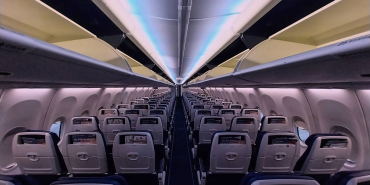
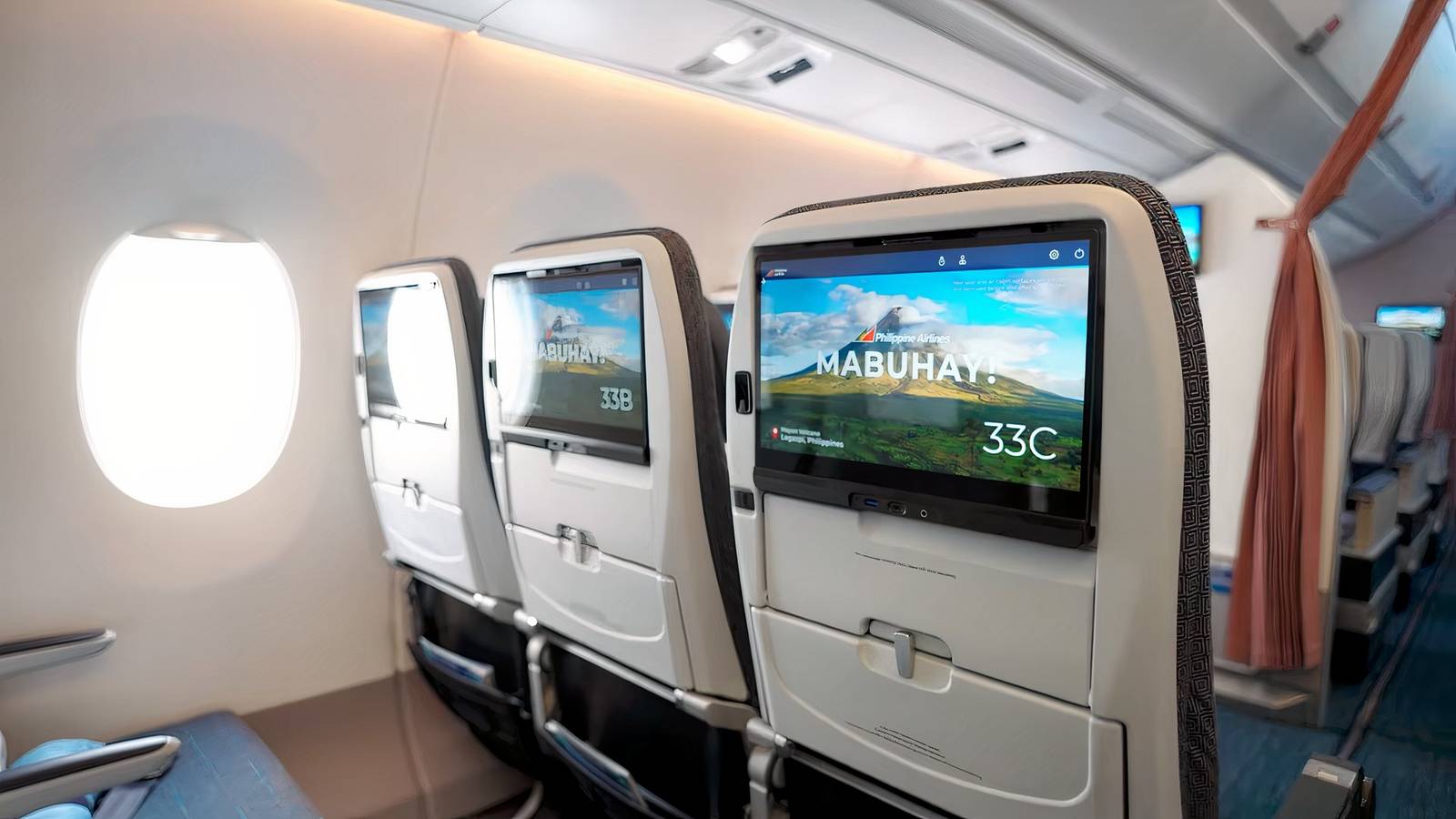
PAL installs the ZIM ZP230 seats for economy, and I personally found the seat to be a mixed bag overall. The colors, materials, and finishes (CMF) were pretty good, while I found the cabin design as a whole to be visually appealing and modern. As you can see in the above photo, the seat features a folding tray table, along with a separate table for mobile devices, a cool feature. An A350 is also a generally nice plane to spend 16 hours inside, with large overhead bins, pretty mood lighting, and high ceilings.
Regarding technology, PAL offers USB-A and USB-C ports, which were greatly appreciated (but no universal power ports), along with a 13.3-inch (33.78-centimeter) 4K screen. As someone who doesn’t count how many entertainment options each airline offers, I found that PAL’s movie and television selections were pretty good. However, I checked PAL’s entertainment options online before my flight and found that many of the options shown on its website were simply not there on the actual flight, nor were they present on my subsequent A321 flight.
The seat reclines six inches, and the bottom part slides forward to preserve personal space. However, while PAL advertises a pitch of 32 inches (81.28 centimeters), I found that the bottom part of the seatback and the storage pocket stuck out more than I expected. I find that Qatar’s Recaro seats and United’s Collins seats are much better at carving out knee space, even with a lower seat pitch. I also had a difficult time staying comfortable (likely a function of the padding), which did not happen with Qatar Airways, nor with United in the past.
I found the cabin crew to be friendly and approachable, but what surprised me was that PAL provides a physical menu to economy passengers, which I’ve never experienced before in economy. Another pleasant surprise was the amenity kit, which included a sleeping mask and socks, along with a hot towel service before the final meal service. As someone who usually flies with US carriers, this was unexpected. I also received a blanket (which I found quite thin), a standard pillow, and standard headphones.
I recently stopped eating meat and fish, but my personal experience is that airlines usually offer a vegetarian or chicken option for economy meals, so I didn’t bother pre-ordering. This proved a mistake, as the dinner service consisted of either pork or fish. The crew did not have a spare vegetarian meal, so I ended up eating bread, a salad, and a cake for dinner. This was fine for me because I ate before my flight, but it taught me a valuable lesson: check the meal options online before the flight, and if it’s not available, preorder the vegetarian meal.
Fried fish tilapia in Filipino-style sweet and sour sauce served with peppers, onion, and tumeric rice
Served with mushroom, tomato, and garlic rice
Slow cooked pork stew served with potatoes and vegetable medley
The mid-flight snack consisted of a leek-and-chicken empanada, which was surprisingly filling, while the breakfast option was either prawns sarciado or scrambled eggs with cheddar cheese, hashbrowns, and turkey bacon. I selected the eggs, which were flavorful, and so was the hashbrown. As a whole, as someone who isn’t a food critic, I found the meals more than adequate for economy.
PAL installs Viasat WiFi on the A350-1000, and this was complimentary on my flight. However, I was unable to actually use it for several hours, and when I asked the cabin crew for assistance, they couldn’t figure out why my phone couldn’t connect to the WiFi. When I finally connected, I found that speeds and loading times were good, but my later flights on Qatar Airways offered Starlink. Everyone has called Starlink ‘game-changing,’ and I agree; the speeds and loading times were far beyond anything I’ve ever experienced on an aircraft.
Which airlines are raising the bar for economy class comfort?
As a whole, I feel as though PAL offers one of the better transpacific economy experiences on the market. In particular, the soft product was elevated compared to what I’m used to, with good catering, friendly service, and a nice selection of amenities for economy. The technology is as good as every other new economy seat out there, and while I criticized the legroom/kneeroom situation, it’s not dramatically worse than other airlines. I also had a hard time finding a comfortable position, but this might not be the case for everyone.
What I’m struggling with is the ten-abreast layout. It is noticeably tighter than any other aircraft I’ve ever been on, and it truly feels like a new bottom standard for long-haul travel on full-service carriers. On one hand, the large economy cabin probably allows PAL to charge lower prices for its flights, and I booked this flight specifically because it was by far the cheapest option between New York and Singapore on the dates that I was traveling. However, if that middle seat had been occupied, then the experience would have been suffocating.
Funnily enough, Philippine Airlines offers passengers the opportunity to block the middle seat (which went for $170 on my flight), and it also allows you to block an entire section of seats for a higher fee. I did not purchase this add-on, meaning that either the passenger in the aisle seat did or I simply lucked out, and there were almost no empty seats on my flight. It will probably be good enough if you’re fairly small, but personally, I’ll only book PAL on the A350-1000 again if the price is significantly lower than other airlines.
Orijinal Haberi Görüntüle