
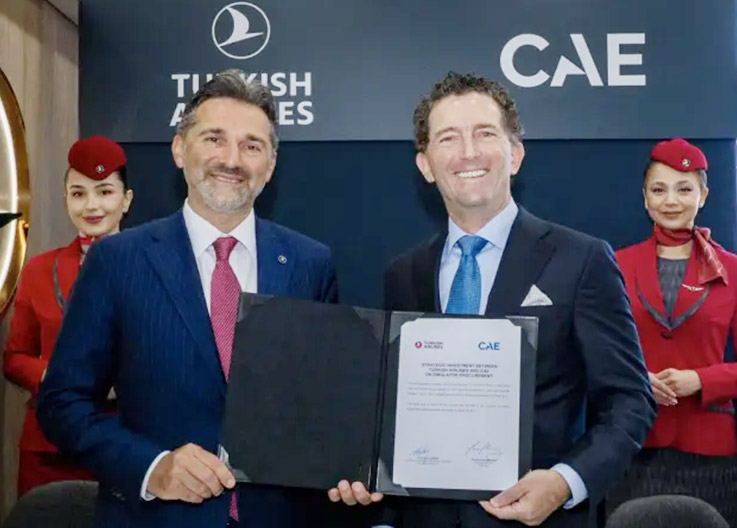


Turkish Airlines signed a new contract with CAE at Farnborough for 5 simulators, 2 training devices and 2 options in order to increase its pilot training capacity.
Turkish Airlines signed a new contract with Canadian Aviation Electronics (CAE) at the Farnborough International Airshow in order to increase its pilot training capacity in parallel with its growing fleet and strengthen its training infrastructure with advanced technologies. The agreement covers 5 Full Flight Simulators, 2 Flight Training Devices and options for 2 additional Full Flight Simulators.
The contract will support Turkish Airlines’ capacity expansion efforts carried out in line with its 10-year flight training investment plan. The new training devices will be used in the training processes of pilots who will serve in the company’s narrow-body and wide-body aircraft fleets.
Capacity of the New Flight Training Center to Be Increased
The simulators and training devices to be acquired under the agreement will also contribute to Turkish Airlines’ new training investments, the foundations of which were laid last January.
The first phase of the simulator hangars is planned to become operational in 2027, while the new Flight Training Center is expected to be completed in 2028. The devices to be supplied by CAE are intended to increase the center’s pilot training capacity.
Şeker: We Will Strengthen Our Training Infrastructure
Commenting on the agreement, Turkish Airlines Chairman of the Board Prof. Dr. Murat Şeker stated that pilot training infrastructure is an important part of the company’s long-term growth strategy.
Şeker used the following statements in his remarks:
“As we continue to expand our fleet and global flight network, further strengthening our pilot training infrastructure forms an important part of our long-term growth strategy.
These advanced training devices, which will further strengthen our long-standing cooperation with CAE, will make a significant contribution to training our pilots who will serve on different aircraft types with the highest understanding of safety, standardization and operational excellence.
With this agreement, while meeting the increasing training needs of our growing operations, we will continue to maintain the world-class service quality that our passengers expect from Turkish Airlines.”
CAE: A Strong Indicator of Our Cooperation
CAE President and Chief Executive Officer Matthew Bromberg stated that the agreement is an important indicator of the long-standing cooperation between the two companies.
Bromberg said:
“This agreement is a strong indicator of our long-standing cooperation with Turkish Airlines and of the company’s confidence in CAE as a strategic partner in developing its pilot training capabilities.
For more than two decades, we have been working together to support Turkish Airlines’ growth and evolving training needs.
With this comprehensive fleet of training devices for Airbus and Boeing aircraft types, we will continue to provide advanced, high-fidelity simulation solutions that will help Turkish Airlines increase its pilot training capacity, maintain the highest safety standards and support its long-term objectives.”
Which Types of Simulators Will Be Acquired?
The training devices to be delivered to Turkish Airlines by CAE under the agreement are as follows:
- 2 Airbus A321neo Full Flight Simulators
- 2 Boeing 787 Full Flight Simulators
- 1 Airbus A350 Full Flight Simulator
- 2 Airbus A350 Level 1 Flight Training Devices
- 1 optional Airbus A350 Full Flight Simulator
- 1 optional Boeing 787 Full Flight Simulator
The next-generation simulators and flight training devices will increase Turkish Airlines’ pilot training capacity across its narrow-body and wide-body fleets. The devices will also provide a solution to the long-term training needs of the company’s growing global operations.
With the new agreement, Turkish Airlines aims to strengthen its long-standing cooperation with CAE while further developing its technology-focused, sustainable and scalable approach to pilot training.