
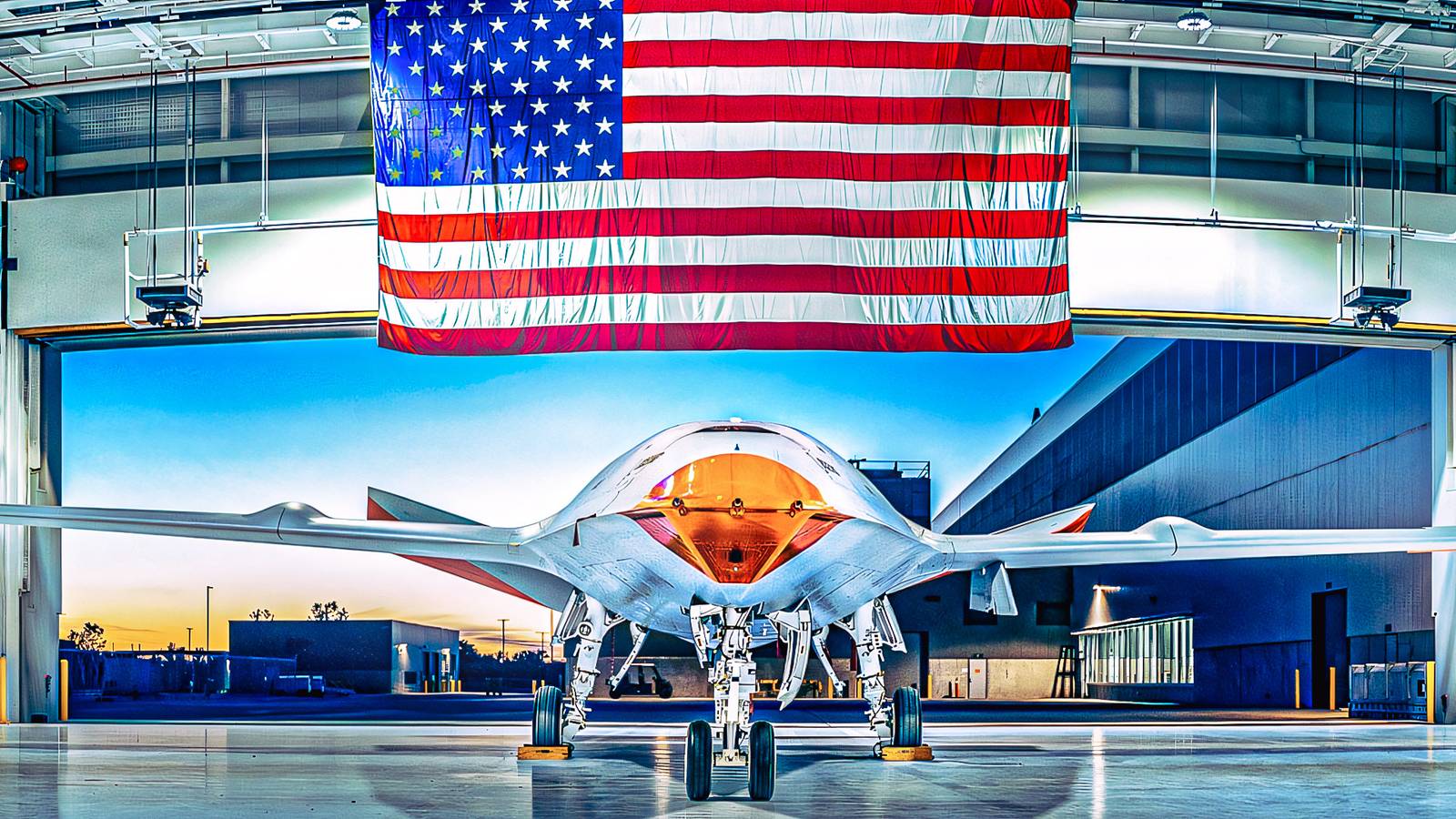


On June 25, 2026, a Boeing MQ-25 Stingray demonstrator was lashed to the deck of USS Nimitz as the carrier took part in FLEETEX 25 alongside 25 allied warships in the Atlantic. The aircraft was Boeing’s T1 test demonstrator, displayed without its Cobham aerial refueling pod. According to the Defense News, aerial refueling can consume more than one-third of all F/A-18E/F Super Hornet flight hours during carrier air wing operations, diverting strike fighters from the combat missions they were designed to perform. The MQ-25 Stingray is intended to take over that mission, returning those aircraft to offensive operations.
The question worth following here is not whether the Stingray works. It works just fine: it refueled a Boeing F/A-18F in June 2021, then a Lockheed Martin F-35C, then a Northrop Grumman E-2D Hawkeye, all without incident. The question is what it takes to put an aircraft like this on a carrier permanently, why a program originally scheduled for initial operational capability in 2024 is now targeting Q2 FY2029, and what happens to the carrier’s strike calculus the moment 20 to 33% of its Super Hornets get their pylons back.
The F/A-18 Is Not A Tanker — But Up To A Third Of Them Are Flying As One
The F/A-18E/F Super Hornet’s “buddy tanking” mission requires the aircraft to carry a D-704 Aerial Refueling Store under the centerline station, a fuel hose pod that can transfer fuel to receiver aircraft in flight. The aircraft performing this mission does so instead of carrying weapons, is functionally unavailable for strike or defense, and returns to the carrier with reduced fuel of its own after giving away what it took off with.
According to Simple Flying’s detailed analysis of what the MQ-25 replaces, the buddy tanker mission currently requires every carrier air wing to dedicate approximately 20 to 33% of its Super Hornets that could otherwise fly combat missions. For a typical air wing of 44 strike fighters, that is between nine and fifteen aircraft flying with hoses instead of AGM-84 Harpoon missiles.
The buddy tanking burden is not a recent problem. The Navy retired the Lockheed KS-3B Viking tanker in 2009 and the Grumman KA-6D Intruder before that, betting that dedicated tanking was an inefficiency the air wing could absorb by pressing its Super Hornets into a secondary refueling role. That calculation held during two decades of low-intensity operations where carriers operated close to shore and strikes were unconstrained by fuel margins. The calculation broke as the strategic environment shifted when China developed the DF-26 anti-ship ballistic missile with a range of approximately 2,500 miles (4,000 km) that forces carriers to stand farther off the coast. Fuel margins are no longer an abstraction. They are the constraint that defines whether the carrier can reach its targets at all.
The math behind that constraint is specific and daunting: as stated by TWZ, a Super Hornet flying without MQ-25 support has a combat radius of approximately 450 to 500 nautical miles (833 to 926 km). The MQ-25 can deliver 15,000 lb (6,804 kg) of fuel at a distance of up to 500 nautical miles (926 km) from the carrier, meeting fighters halfway and extending the strike radius of the air wing to over 1,000 nautical miles (1,852 km). The difference between those two numbers (the gap the Stingray closes) is the operational space the Navy needs to keep its carriers alive in the Pacific area.
Why Does A $67 Million Fighter Fly With A Hose Instead Of Missiles?
The immediate answer is institutional inertia combined with the absence of an alternative. When the KS-3B Viking retired in 2009, the Navy had no replacement ready. The S-3 was a four-seat subsonic jet optimized for the tanker role, and its retirement left the air wing without a dedicated organic tanking asset. The Super Hornet filled the gap because it was the only large aircraft on the flight deck capable of doing so, not because anyone thought it was an efficient use of a combat aircraft. As Simple Flying has documented in its analysis of the Super Hornet’s continued relevance in 2026, the F/A-18’s “buddy refueling” role using an ARS pod is widely acknowledged as suboptimal, it reduces the available strike fighters per sortie, generates wear on airframes performing a mission they were not designed for, and exposes trained combat pilots to the fuel-transfer risk without the combat payoff that justifies it.
The cost argument compounds the mission argument. An F/A-18E carries a flyaway cost of approximately $67 million. A pilot trained to fly it costs the Navy well over $10 million in training pipeline expenses. Both are committed to a mission that delivers no offensive output: no strike sorties, no fleet defense, no electronic warfare, but instead simply moves fuel from one aircraft to another. The MQ-25A is sized for exactly this mission at a flyaway cost of approximately $181.6 million, which sounds expensive until accounting for the combat fighters it frees, the training pipeline it preserves, and the missions the returned aircraft can fly. The Navy’s own website for VUQ-10, the Stingray’s Fleet Replacement Squadron, frames the arithmetic in plain terms:
“The MQ-25 increases the overall lethality of the CVW by relieving the F/A-18E/F Super Hornet of the aerial refueling mission, enabling ordnance to replace refueling stores on the F/A-18’s pylons.”
That framing captures the transformation precisely. When the MQ-25 takes over, every former “mini tanker” Super Hornet becomes a combat aircraft again without changing the number of jets on the carrier deck. The air wing gains strike mass without gaining airframes. What the Navy has not fully answered is how a drone becomes structurally indistinguishable from a crewed aircraft in the most challenging aviation environment on Earth: the carrier flight deck.
The F-35B’s lift fan allows NATO jets to operate from Finnish roads. That capability is especially important near Russia.
What Does An Autonomous Catapult Launch Actually Require?
The catapult launch is the carrier flight deck’s most violent routine event. As Simple Flying has described, a carrier aircraft accelerates from zero to approximately 150 miles per hour (241 km per hour) in roughly two seconds under the catapult’s steam or electromagnetic force, subjecting airframe, electronics, and the pilot’s body to extraordinary G-forces.
A drone undergoing this without a pilot must validate not just that its airframe survives but that its Vehicle Management System computers maintain stable control during the violence of the launch, the transition through wake turbulence behind the carrier, and the initial climb to altitude. The T1 demonstrator validated the fundamental aerodynamics of the MQ-25 design. The production aircraft is proving the full envelope required for carrier certification.
The April 25, 2026, first flight confirmed that the production-representative MQ-25A can autonomously taxi, take off, fly a pre-planned mission profile, and land — all controlled from a ground-based Unmanned Carrier Aviation Mission Control System (UMCS) MD-5 station that integrates Lockheed Martin’s MDCX software. Both Boeing and US Navy Air Vehicle Pilots operated the drone from the ground control station during the two-hour sortie over southern Illinois. The test followed an aborted attempt on April 22, for which no technical cause was publicly disclosed. According to USNI News, the next milestone is carrier suitability testing at Patuxent River Naval Air Station/Trapnell Field Airport (NHK), Maryland, building toward actual carrier qualification — the catapult launches and arrested landings that determine whether the Stingray can survive and operate on a flight deck at sea.
The drone’s physical dimensions make carrier integration genuinely challenging. Rear Admiral Stephen Tedford made the scale explicit at the Navy League Sea Air and Space symposium, as reported by the US Naval Institute:
“People don’t realize how big the actual MQ-25 is. It’s as long as an F-18 with the wingspan of an E-2. It’s not a small UAV. “
An aircraft with the wingspan of a Northrop Grumman E-2D Advanced Hawkeye, approximately 80 feet (24.4 meters), requires the same careful deck procedures as any large carrier aircraft, but without a pilot to exercise judgment when something unexpected happens. That challenge is what the 2024-to-2029 IOC slip is fundamentally about.
A Production Aircraft Finally Flew — So Why Does IOC Remain Three Years Away?
The MQ-25 program’s schedule history is a study in the compounding costs of ambition meeting reality. Initial operational capability was originally planned for 2024, then it slipped to late 2026. The FY2027 budget request now places IOC in the second quarter of FY2029, with Initial Operational Test and Evaluation planned between Q2 and Q4 of the same fiscal year. The definition of IOC is precise: three MQ-25As with trained personnel and equipment, deployed on an MQ-25A-capable aircraft carrier. The delays have stemmed from a combination of carrier availability constraints, production manufacturing challenges, and the sheer difficulty of certifying autonomous carrier aviation for the first time in the Navy’s history.
The production ramp reflects the Navy’s measured approach to risk. The FY2027 budget request includes three MQ-25s for $771 million — a per-unit cost that reflects the early low-rate production phase. The build rate is projected to increase from three aircraft per year currently to five per year in 2028 and seven per year in 2029. The total acquisition of 76 Stingrays (including nine test aircraft) at a $181.6 million flyaway unit cost represents a program valued at approximately $13.8 billion. As Simple Flying reported at the production aircraft’s first flight, NAVAIR’s Rear Admiral Tony Rossi described the MQ-25 as the first step towards bringing autonomous aerial refueling to the carrier air wing, extending the reach and endurance of crewed fighters. Carrier qualification, fleet training, and the establishment of VUQ-11 and VUQ-12 as operational Stingray squadrons are all ahead.
The Block III Super Hornet carries its own answer to the question of how pilots interact with the Stingray. As Simple Flying has detailed in its examination of the manned-unmanned teaming interface, the Block III’s DTP-N mission computer provides 17 times more processing power than legacy systems, paired with the Tactical Targeting Network Technology (TTNT) high-speed datalink. A Super Hornet pilot can command a Stingray to release its refueling drogue via touchscreen, and, in ISR mode, can direct the drone to investigate a specific area of interest, receiving imagery in real time without diverting the carrier air wing’s crewed assets. That secondary ISR capability is not what the Navy bought the Stingray to do, but it is what makes the aircraft more than a flying fuel truck once it is on station.
With over four million flight hours and continuous upgrades, the combat-proven Super Hornet remains a cornerstone of carrier air wings.
When The Stingray Gets Its Pylons Back: What Changes For The Carrier Air Wing?
The arrival of MQ-25 fundamentally changes how carrier strike packages are constructed. Today, air wing commanders must allocate a fixed portion of F/A-18E/F Super Hornets to the refueling role before any strike planning begins. Those aircraft are not available for weapons carriage. With MQ-25A Stingrays integrated into the air wing, that refueling burden shifts off crewed fighters and onto a dedicated unmanned fleet. Strike planning no longer starts by subtracting tankers; it starts with the full fighter inventory.
The operational effect compounds with range. Positioned roughly 500 nautical miles (926 km) from the carrier, MQ-25 extends the reach of F/A-18s and F-35Cs to more than 1,000 nautical miles (1,852 km), effectively doubling unrefueled combat radius. In a Western Pacific scenario, that change matters because it allows carrier strike groups to operate outside the inner engagement envelope of systems such as the DF-26 while still maintaining strike access to high-value targets ashore. The MQ-25 gives the existing carrier the range to fight from the position its commanders want it in, rather than the position the threat forces it into.
The remaining question is scale. Early operational capability in 2029 will likely field only a handful of MQ-25s, while meaningful carrier-level impact requires roughly 20–24 aircraft per air wing. At the planned production rate, that threshold is unlikely to be reached until the early-to-mid 2030s. The result is a long transition period in which the MQ-25 exists operationally, but does not yet fully reshape carrier air wing architecture.
MQ-25 Is The Entry Point, Not The Destination
The US Navy has been explicit that the Stingray is not a one-off program. Navy leaders have consistently framed it as the entry point for all carrier-based unmanned aviation — the platform that proves autonomous catapult launch, arrested recovery, and flight deck integration are operationally achievable at scale, so that what comes after it does not have to prove those things again from scratch. Two additional operational squadrons, VUQ-11 and VUQ-12, are planned to follow VUQ-10. Future carrier-based unmanned systems, including armed variants that the MQ-25’s current configuration specifically does not include, depend on the institutional and engineering precedents the Stingray sets.
The specific number to watch is not the IOC date itself but what the production ramp does after it. At seven aircraft per year from 2029, reaching a full complement of 20 to 24 Stingrays per carrier air wing, will require approximately until 2032 to 2034. Whether Congress sustains that production rate across multiple budget cycles is the constraint that will determine whether the MQ-25’s range extension becomes a fleet-wide capability or remains a capability in principle.
The harder question is whether the Navy proceeds with an armed MQ-25 variant. Conceptual models have shown the aircraft carrying AGM-158C LRASM anti-ship missiles. No such variant is funded or formally proposed. But the same platform that can deliver 15,000 lb of fuel at 500 nautical miles can carry 15,000 lb of something else to the same distance, and whether the Navy asks Boeing to explore that is the open question that the Stingray’s entry into operational service will eventually force onto someone’s desk.
Orijinal Haberi Görüntüle