


Asked to picture an autonomous Collaborative Combat Aircraft (CCA), most will describe the same thing: an unmanned, armed jet-powered drone flying alongside a manned fighter.
That picture is already out of date. The CCA of 2030 will likely look less like a flying weapons magazine and more like the proverbial Swiss Army knife that can conduct electronic warfare in one sortie, relay targeting data in another, and loiter over contested territory doing missions that no manned fighter could risk doing.
“The introduction of unmanned systems that pair with manned aircraft can shift the dynamics of what’s happening, what kind of missions are being performed,” said Matthew Milas, president of Honeywell Defense & Space, talking as part of a Breaking Defense video series on the future of military aviation. “A lot of people think of them as missile trucks, but there’s a lot more capabilities that can be incorporated if you’re incorporating things like electronic warfare, other RF signaling. The way that they can interact and provide a persistence of deployment can change how we operate in the battlefield.”
That ambition didn’t emerge overnight. To understand where the Pentagon is heading with CCAs and how it has gotten here, it’s important to review the ups and downs along the timeline of uncrewed development.
The lineage of manned-unmanned teaming stretches back to World War II with Operations Aphrodite and Anvil. The plan was for crews to fly explosive-laden bombers partway to a target before bailing out and letting a mothership attempt to radio-guide the now-unmanned bomber the rest of the way. President John Kennedy’s brother Joseph was killed in just such a mission when his plane prematurely exploded.
The concept resurfaced after 9/11, according to Caitlin Lee of the RAND Corporation, when the Army eventually formalized a manned-unmanned teaming doctrine around 2010, pairing Apache helicopters with Raven and Shadow drones for reconnaissance and strike. What distinguishes today’s CCAs from that history – and from the small attack drones proliferating over Ukrainian front lines – is their kinship with fighters, tasked and controlled by the same units, and often with much of the same cockpit configuration as the manned aircraft they’re partnered to.
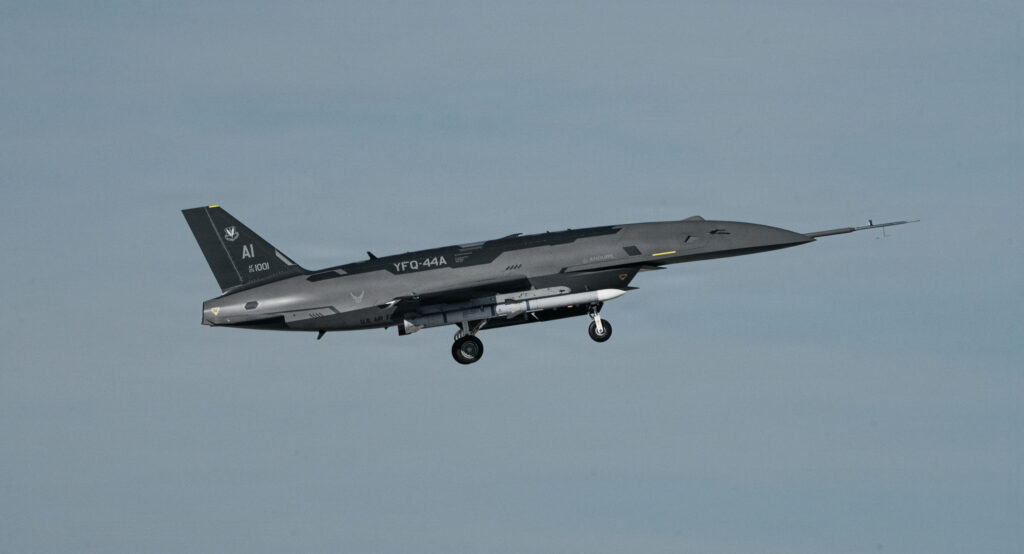
The Air Force’s effort is furthest along of US services. Increment 1 is envisioned as roughly 100 simple bomb-and-missile-carrying CCAs meant to let operators experiment with the concept. It’s gone more slowly than planned, but initial contracts were awarded to General Atomics and Anduril in recent weeks. Increment 2, once conceived as a more maneuverable, exportable design developed with foreign partners, has effectively been redefined as whatever the Air Force decides to buy next. Increment 3 is envisioned as a higher‑capability, US‑only version of Increment 2.
The CCA program is unusual in running three separate competitions simultaneously – airframe, engine, and control software – and the Air Force has already demonstrated swapping one vendor’s control software for another’s in flight, according to Lee.
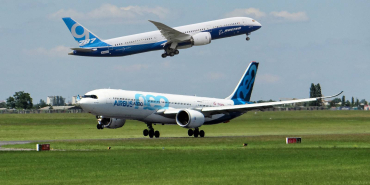
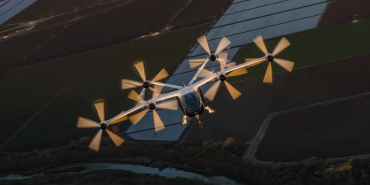
The other services are pursuing parallel paths: the Navy has issued early conceptual contracts to Anduril, Northrop Grumman, General Atomics, and Boeing for a carrier-based drone wingman; the Marine Corps has paired Northrop Grumman with Kratos’ Valkyrie drone; and the Army has floated VTOL concepts that suggest CCAs need not be jet-powered at all. Internationally, Airbus and startups like Germany’s Helsing and its CA-1 Europa CCA are developing their own teaming concepts, while the Netherlands has said it wants to partner with the US Air Force on CCAs.
“An important thing to remember specifically about Europe is that a lot of Europe’s tactical combat aircraft fleet in the future is going to be F-35s,” said JJ Gertler of the Teal Group, also participating in the Breaking Defense video series. “For Europeans right now there’s this big push for indigenous investment in technology, but the fact of the matter is that at least the way I look at things, I think for many European countries, they are happy to let the US kind of work out some of the kinks first and leverage that investment when the time is right.”
A bigger question is whether the industrial base can actually deliver CCAs at the scale being discussed. The absence of common technical standards is one of the program’s most consequential unsolved problems, according to Milas.
“Unfortunately, right now, there are none,” he said of industry-wide standards for how CCA subsystems interface and interact. “Everybody is piecing together their own solutions,” redeveloping basic foundational technologies like wheels and brakes, actuation systems, and power and thermal management from scratch rather than building on shared groundwork. “It’s a big opportunity for how we make CCAs affordable and producible at the scale that’s being demanded.”
Milas also noted that attritable doesn’t mean disposable. “These are going to be things that we want to get flight hours out of,” he said, describing aircraft expected to return from missions, be serviced, and fly again.
That reality collides with an aerospace industry whose profits have historically come from decades-long sustainment of complex platforms, not short production runs of iteratively redesigned aircraft. Said Gertler, “The traditional defense primes are built for success,” while “the new entrants more and more are designed to fail,” treating early failure as a step along the way to producing minimally viable products. Government mandates for open architectures and organic sustainment, designed to prevent vendor lock-in, further erode the long-term revenue streams contractors have traditionally relied on.
The supply chain pressure extends well beyond the CCA program itself. Milas described “the entire aerospace industrial base” as “really challenged right now,” with commercial, business aviation, and defense all competing for the same pool of suppliers for castings, forgings, and bearings.
Simply adding domestic capacity, he argued, won’t be fast enough; adding more suppliers in the US isn’t going to make a dent in the near term to meet all of the demand.
His answer is commonality. “The more common and high-volume production that we can get into, the better it is for the nation.” On propulsion specifically, CCA Increment 1 has leaned on off-the-shelf business-jet engines like the Williams FJ44 to enable near-term production.
Resilient navigation should be another common element: “If you don’t have an alternate navigation, an anti-jam solution, you’re just throwing metal at an object,” he said.
How Soon, How Many?
Another consideration is CCA command and control, in other words, the human factor. Current Pentagon guidance lets CCAs manage their own flight paths but requires a human pilot to authorize target engagement. This model shifts decision-making from human “in the loop” to human “on the loop,” analogous to how the Patriot air-and-missile-defense system already operates with significant autonomy because air-defense reaction times preclude waiting for human input. Whether a single fighter pilot can meaningfully supervise multiple CCAs while flying a high-speed combat mission under fire remains an open question, as does how the US reconciles its commitment to human oversight with adversaries like China and Russia that don’t.
On the potential market for CCAs, Milas called it “very significant as far as what it is, thousands of these types of aircraft,” pointing to a spectrum of interest ranging from Group 3-class systems to full-size fighters and trainers converted to unmanned operation.
Getting there, however, may require a clear operational driver. RAND’s Lee drew the comparison to an earlier inflection point: “I go back to thinking about the Predator, the Predator before 9/11, not a ton of interest in the Predator before there was a clear sort of strategically relevant operational problem to solve, which was high-value targeting and killing bin Laden.” That urgency, she suggested, still hasn’t fully arrived for CCAs.
Orijinal Haberi Görüntüle