


Japan Airlines is starting to test humanoid robots in baggage and cargo operations at Tokyo Haneda Airport. Japan is accelerating its robotic transformation in aviation in response to the growing number of tourists and the workforce crisis.
Japan Airlines is launching a robotic transformation in Tokyo in response to increasing tourist traffic and a deepening labor shortage
Japan Airlines is taking a remarkable step that could change the understanding of ground handling services in the global aviation sector. The company is preparing to use humanoid robots on a trial basis in baggage and cargo operations at Haneda Airport in Tokyo.
The implementation, which will begin in May, is not just a technological demonstration; it represents a strategic response developed by Japan to address its aging population, shrinking workforce, and rapidly increasing tourist pressure.
The Era of Robots on the Baggage Apron
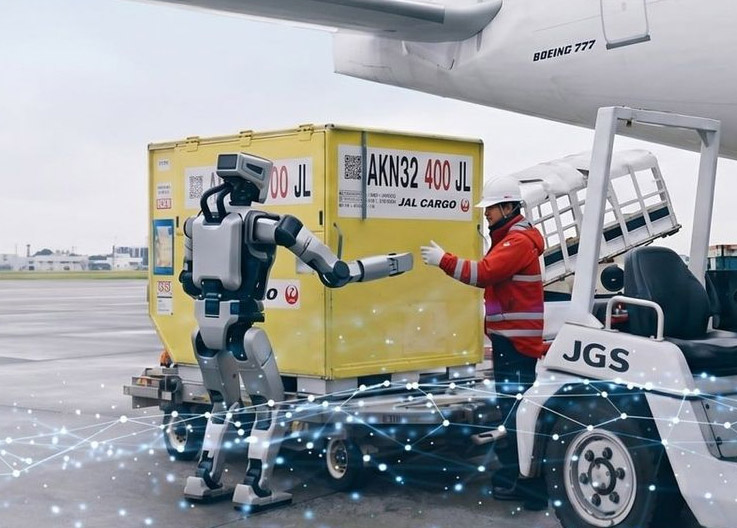
The humanoid robots, approximately 130 centimeters tall and developed by China-based Unitree Robotics, will be used in physically demanding tasks such as baggage and cargo handling at Haneda.
The deployment of these robots at a high-density hub like Haneda, which serves more than 60 million passengers annually, may not completely replace human labor in airport operations but could reshape the distribution of workload. During the demonstration, the robots carefully placing cargo onto a conveyor belt next to a passenger aircraft showed that the technology is moving closer to operational use, not just theoretical application.
The Goal Is Not to Replace Staff but to Fill a Critical Gap
Yoshiteru Suzuki stated that the robots will reduce the burden on workers performing physically demanding tasks, while emphasizing that areas requiring critical decision-making, such as safety management, will remain under human control.
The automation of Japanese aviation will follow a “workforce support model” rather than “full replacement.” In other words, robots will create a new layer that supports human resources in the most physically demanding areas of the apron rather than replacing roles in the cockpit or security.
Japan’s Real Challenge: Tourism Boom and Population Decline
Japan’s investment in robotics cannot be explained solely by technological curiosity. The country is facing two major pressures simultaneously:
Record Growth in Tourism
According to data from the Japan National Tourism Organization, more than 7 million visitors entered the country in the first two months of 2026. In 2025 overall, a historic record was broken with 42.7 million tourists.
Decline in the Working-Age Population
Due to an aging population and low birth rates, Japan is experiencing a serious labor shortage, particularly in sectors requiring physical work. Estimates suggest that the country will need more than 6.5 million foreign workers by 2040 to sustain its economic growth targets.
Due to political pressures on immigration policies, it appears difficult to fill this gap solely with foreign labor. Therefore, robotic systems are no longer a technological choice for Japan; they are becoming an economic necessity.
Haneda Trial Will Continue Until 2028
The project, carried out in partnership with GMO Internet Group, will be tested until 2028. The robots are planned to be used not only for baggage handling but also in different operations such as aircraft cabin cleaning.
The robots, capable of operating continuously for two to three hours, could create a long-term transformation in airport operational costs if properly integrated into shift structures. However, the determining factors will be safety, error rates, and operational sustainability.
A New Model for Global Aviation?
If the application at Haneda proves successful, this model may not remain limited to Japan. As the shortage of ground handling personnel grows at major hub airports in Europe, North America, and Asia, humanoid robots could become a new-generation apron support system.
This raises a key question for the aviation industry: Will human labor be completely reduced at the airports of the future, or will technology simply establish a more sustainable workforce balance?