
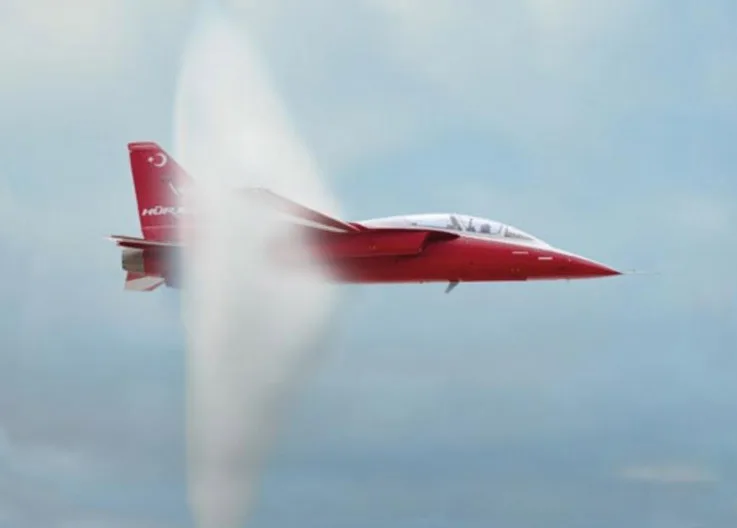


Turkey’s domestically developed jet trainer, HÜRJET, has marked a historic milestone in Turkish aviation. During a test flight on October 21, 2024, HÜRJET successfully broke the sound barrier, achieving a significant breakthrough for the defense industry.
On the morning of October 21 at 09:45, the HÜRJET Jet Trainer took off from Mürted Air Base in Ankara. During its 38th test flight, it exceeded Mach 1, reaching supersonic speeds. This achievement validated HÜRJET’s transonic and supersonic flight capabilities, marking a critical milestone in its development.
The development of HÜRJET began in 2017 under the coordination of the Presidency of Defense Industries (SSB). The aircraft made its maiden flight on April 25, 2023, and is set to enter serial production, with its induction into service planned for 2026.
HÜRJET’s Technical Features and Development Timeline
HÜRJET was developed domestically by Turkish Aerospace Industries (TUSAŞ) using national resources. Comprising 8,000 components, it features a single-engine design with a modern avionics cockpit.
Key project milestones:
- 2017: Jet Trainer Development Project initiated.
- 2018: Conceptual design completed.
- 2019: Preliminary design phase finalized.
- 2021: Critical design phase completed, part production began.
- 2023: First flight conducted.
- 2024: Broke the sound barrier.
What Is the Speed of Sound?
Sound travels as pressure waves through a medium via mechanical vibrations. In the atmosphere, the speed of sound varies based on molecular properties. An object reaches the sound barrier when it attains Mach 1.
- Mach < 1: Subsonic speed.
- Mach = 1: Speed of sound.
- Mach > 1: Supersonic speed.
In transonic speeds (Mach 0.8–1.3), shock waves around the aircraft increase drag. At supersonic speeds (Mach > 1.3), aerodynamic challenges intensify, requiring specialized design solutions.
The Importance of Supersonic Flight in Aviation
HÜRJET’s ability to achieve supersonic flight is not just an engineering feat—it also demonstrates the level of technological advancement in Turkey’s defense industry. Supersonic aircraft are vital for modern fighter jets and training platforms.
Key challenges in supersonic flight include:
- Shock Waves: At supersonic speeds, shock waves around the aircraft increase drag and complicate aerodynamics. Overcoming these challenges requires:
- Thin, low-camber wing profiles.
- Aerodynamically optimized fuselage design.
- High-thrust engine systems.
TUSAŞ and the Future of Turkish Aviation
HÜRJET, along with the National Combat Aircraft (KAAN), has expanded Turkey’s expertise in transonic and supersonic flight technologies.
These projects lay the foundation for future advancements and reinforce Turkey’s position in the global aerospace industry.
HÜRJET breaking the sound barrier is a landmark achievement for Turkish aviation. Once serial production and operational deployment are complete, it will serve as a critical asset for both training and combat missions. (tolgaozbek)
© AeroHaber.com
Aviation News and Defense Industry news published on our website cannot be used without proper attribution.