


Brandon’s passion for aviation started at a young age. Growing up, he was involved in the flight simulator and VATSIM communities, and he went on to earn his private pilot license while in college. Brandon holds a BSE in computer science and currently works as a software engineer. Outside of work, he continues to build flight hours and explore new airports around the country.
A Boeing 777 main gear tire supports over 50,000 lb (22,680 kg), operates at 200 PSI, and goes from stationary to 170 mph (274 km/h) in a fraction of a second at touchdown. It does this roughly 200 times before needing a retread, and the same carcass can be retreaded up to seven times before it is retired from service. The engineering behind that performance is built into every layer of the tire, from the nylon and aramid cord plies that carry the load to the steel bead bundles that lock it to the wheel rim.
Aircraft tires operate under conditions that no automotive tire is designed to handle: extreme inflation pressures, rapid temperature swings from -40°F (-40°C) at cruise altitude to over 400°F (204°C) at the contact patch during landing, and impact loads that compress the tire by up to 45% of its height on a firm touchdown. Here is how they are constructed, why they are inflated to six times the pressure of a car tire, and how airlines keep them in service across thousands of landing cycles.
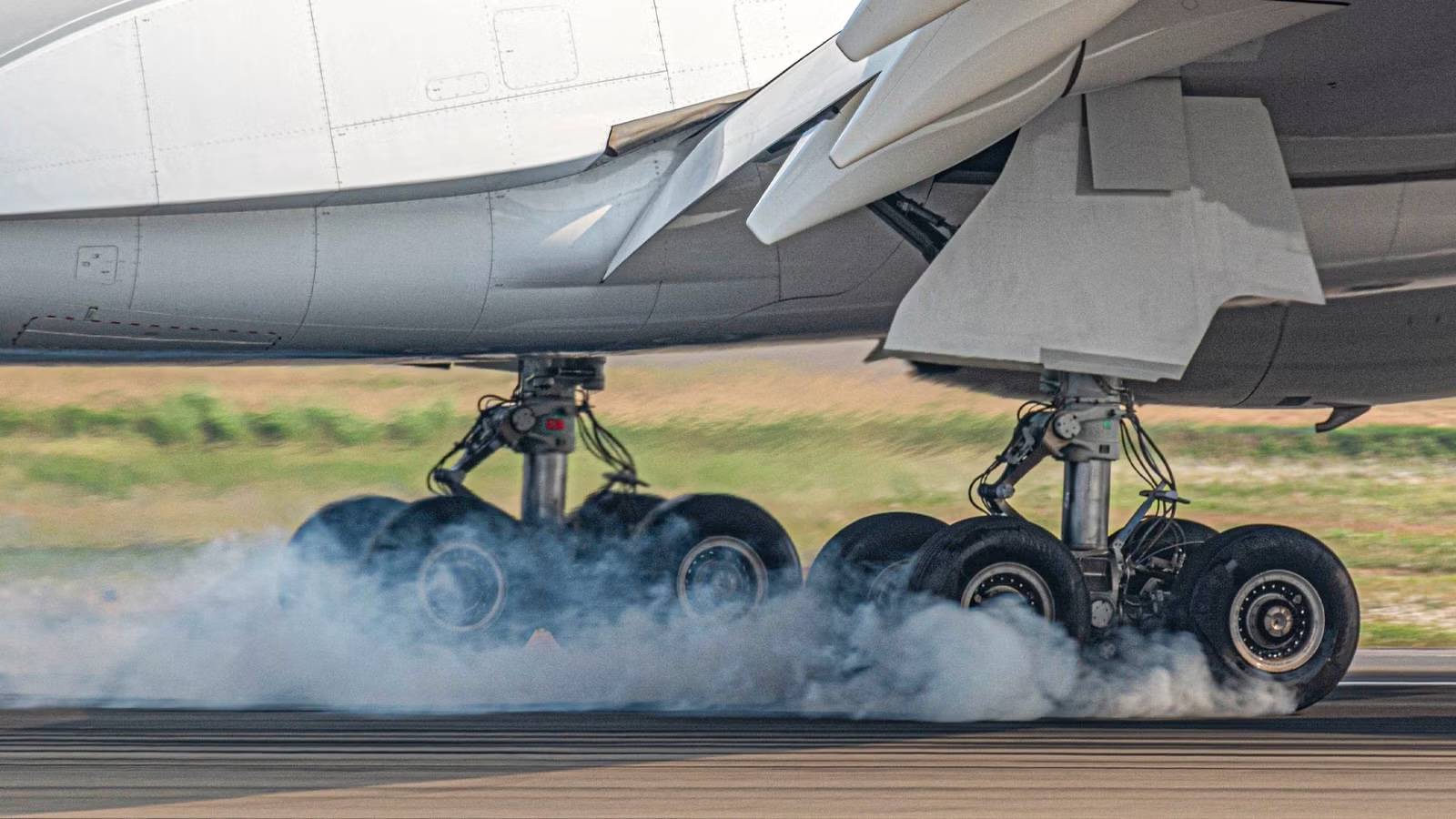
When a commercial aircraft touches down, its tires go from stationary to approximately 150-170 mph (241-274 km/h) in a fraction of a second. The tires are not spinning before contact. Unlike a car tire that is already rotating at road speed, an aircraft tire sits motionless in the wheel well during flight and makes first contact with the runway surface at whatever speed the aircraft is traveling. The initial moment of contact is a skid rather than a roll, with the tire sliding across the pavement until friction accelerates it to the ground speed of the aircraft. The puff of smoke visible on most commercial landings is rubber from the tread surface vaporizing during that brief skid phase.
The load each tire absorbs at touchdown depends on the aircraft type, landing weight, and descent rate. On a Boeing 777-300ER landing at maximum landing weight, each of the 12 main gear tires supports approximately 50,000-55,000 lb (22,680-24,948 kg). The tires deflect by up to 35% under normal rated loads and can reach 45% deflection under the impact loads of a firm landing. That deflection is by design. The tire is engineered to compress and absorb energy rather than resist it, with the sidewall flexing inward to distribute the landing force across the contact patch. A rigid tire would transfer the full impact load directly into the landing gear structure and the airframe.
The temperature at the contact patch during spin-up can exceed 400°F (204°C) briefly before the tire reaches rotational speed and the skid phase ends. Once rolling, the tire generates heat through a different mechanism: cyclic flexing of the sidewall and tread as the loaded portion of the tire compresses against the runway surface with each rotation. On a long taxi after landing or before takeoff, that flexing can raise tire temperatures significantly, which is why tire pressure, tread condition, and brake temperatures are all monitored as part of normal ground operations.
An aircraft tire is built from the inside out in layers, each serving a specific structural purpose. The innermost layer is a butyl or halobutyl rubber liner that functions as the air seal, preventing the high-pressure inflation gas from migrating through the carcass. Outside the liner sit the carcass plies, the primary load-bearing structure of the tire. These plies are made from cords of nylon 66 or aramid fiber coated in rubber and layered at specific angles depending on whether the tire uses bias-ply or radial construction.
In a bias-ply tire, the cords cross the tire from bead to bead at angles less than 90 degrees to the tread centerline, with alternating plies laid in opposite directions. This creates a strong, rigid carcass that resists the high deflections and impact loads of landing. In a radial tire, the cords run perpendicular to the tread at 90 degrees, with additional belt plies above the carcass providing circumferential stiffness. Radial construction produces a more flexible sidewall, a more stable contact patch, and lower rolling resistance than bias-ply, which is why radial tires have become increasingly common on newer commercial aircraft. Boeing 777-300ER main gear tires, for example, are radials with a 36-ply rating, sized at 52 x 21 inches (132 x 53 cm) and rated for pressures up to 200 PSI.
The bead area, where the tire sits against the wheel rim, is reinforced with high-strength steel wire bundles wrapped in additional fabric layers called flippers and chafers. These prevent the tire from slipping on the rim during heavy braking or high-energy landings, where the forces trying to rotate the tire relative to the wheel are significant. The tread compound is formulated for heat resistance and wear rather than the grip characteristics that drive automotive tire design. Aircraft tires do not need to generate lateral cornering force at high speed the way car tires do. They need to survive repeated high-energy spin-ups, resist heat buildup during braking, and shed water through simple circumferential grooves that run around the tire’s surface.
The conductive rubber neutralizes electrical charge in aircraft tires.
Commercial aircraft tires operate at inflation pressures between 150 and 220 PSI depending on the aircraft type and tire position. A Boeing 737 main gear tire runs at approximately 200 PSI. A 777 main gear tire operates at similar pressures. The nose gear tires on most commercial aircraft run slightly lower. For comparison, a standard passenger car tire is inflated to 30-35 PSI. An aircraft tire operates at roughly six times that pressure in a package that is physically smaller relative to the load it carries than any automotive tire.
The high pressure is necessary because the tire must support an enormous load while remaining compact enough to fit inside the landing gear bay during flight. A car tire can be made wider or taller to increase its load capacity at lower pressures. An aircraft tire is constrained by the dimensions of the wheel well, the clearance between the tire and the gear structure, and the weight penalty of a larger tire and wheel assembly. High inflation pressure allows the tire to carry the required load within those dimensional constraints by increasing the stiffness of the carcass and reducing the deflection under load. A tire inflated to 200 PSI deflects less under the same weight than the same tire at 100 PSI, which means it can carry more weight in the same physical footprint.
Aircraft tires are filled with nitrogen rather than compressed air. The reason is thermal stability. Air contains moisture that expands and contracts unpredictably as temperature changes, and the temperature range an aircraft tire experiences in a single flight cycle is extreme. At cruise altitude, tire temperatures can drop below -40°F (-40°C). During landing and taxi, temperatures at the contact patch can exceed 400°F (204°C). Nitrogen is a dry gas that does not contain moisture, which means it expands and contracts more predictably across that temperature range. Using nitrogen reduces the risk of pressure variations that could affect tire performance and eliminates the possibility of moisture-related corrosion inside the wheel assembly.
How Tires Are Inspected, Retreaded, And Replaced
Tire inspections are part of the daily pre-flight walk-around that maintenance crews perform before an aircraft’s first departure. Crew members visually check each tire for tread depth, sidewall damage, cuts, bulges, flat spots from heavy braking, and foreign object damage from runway debris. Tread depth is measured against wear indicators built into the circumferential grooves, similar in concept to the wear bars on automotive tires but subject to stricter minimum depth requirements. Any tire showing cord exposure, sidewall separation, or tread depth below the manufacturer’s minimum is pulled from service before the aircraft departs.
Tire pressure is checked at regular intervals using calibrated gauges, with the aircraft unloaded. A loaded tire reads approximately 4% higher than its actual inflation pressure due to the volume reduction caused by deflection under the aircraft’s weight. Under-inflation is one of the most common causes of premature tire failure on commercial aircraft. A tire operating below its rated pressure deflects more than designed, which increases heat buildup in the sidewall, accelerates carcass fatigue, and can lead to a blowout during takeoff or landing. Maintenance programs track pressure trends over time to identify slow leaks before they reach a critical level.
A commercial aircraft tire lasts approximately 150-200 landing cycles before the tread wears to its minimum depth and the tire requires retreading. The retreading process strips the remaining tread from the carcass, inspects the underlying structure using non-destructive testing methods including shearography, and applies a new tread compound before curing. A single tire carcass can be retreaded five to seven times over its total service life, depending on the condition of the carcass plies and bead structure at each inspection. Retreading costs a fraction of a new tire and produces a tire with equivalent performance certification, which is why the majority of commercial aircraft tires in service at any given time are retreads rather than new units. Changing a main gear tire on a widebody requires hydraulic jacks capable of lifting one side of the aircraft, specialized ground equipment to remove and refit the wheel assembly, and a two-person maintenance team. The process takes approximately 30-45 minutes per tire under normal conditions.
A closer look at the role tires play during a flight.
A Boeing 737 carries six tires: two on each main gear strut and two on the nose gear. A Boeing 787 carries 10: four on each main gear bogie and two on the nose. A Boeing 777 carries 14: six on each main gear bogie arranged in a three-by-two configuration and two on the nose. The Airbus A380 carries 22: four tires on each of four main gear struts plus a center body gear with two tires and two on the nose. The retired Antonov An-225 held the record at 32 main gear tires.
The tire count is driven by the aircraft’s maximum takeoff weight and the need to distribute that weight across a large enough contact area to keep ground pressure within limits that airport pavements can handle. An aircraft with fewer, larger tires would concentrate its weight in a smaller area, potentially exceeding the load-bearing capacity of runways and taxiways at the airports it needs to serve. More tires spread the same weight across more contact patches, reducing the pressure per square inch on the pavement below. The A380 at 1,268,000 lb (575,000 kg) maximum takeoff weight actually exerts lower ground pressure than a 767 at roughly half the weight because its 22 tires distribute the load so broadly.
The tire count also provides redundancy. Commercial aircraft are certified to take off and land safely with one or more tires deflated, and a larger number of tires means each individual tire failure has a proportionally smaller effect on the total load-bearing capacity of the landing gear. A 737 losing one of its four main gear tires loses 25% of its main gear contact area. A 777 losing one of its 12 main gear tires loses approximately 8%. The additional tires also distribute braking energy across more units, reducing the heat each tire and brake assembly must absorb during a rejected takeoff or heavy braking event on landing.
Found an error? Send it info@simpleflying.com so it can be corrected.
Orijinal Haberi Görüntüle