


Welcome to my 212th weekly routes article! While 140+ routes started in the examined period, only a small selection is included in this article. Six mini-stories were chosen; all the services launched between June 10 and 16. You can see last week’s jam-packed edition here.
Air Canada, Air Transat, and WestJet inaugurated five new transatlantic routes in almost as many days, while Iberia reintroduced service to Canada after 30+ years.
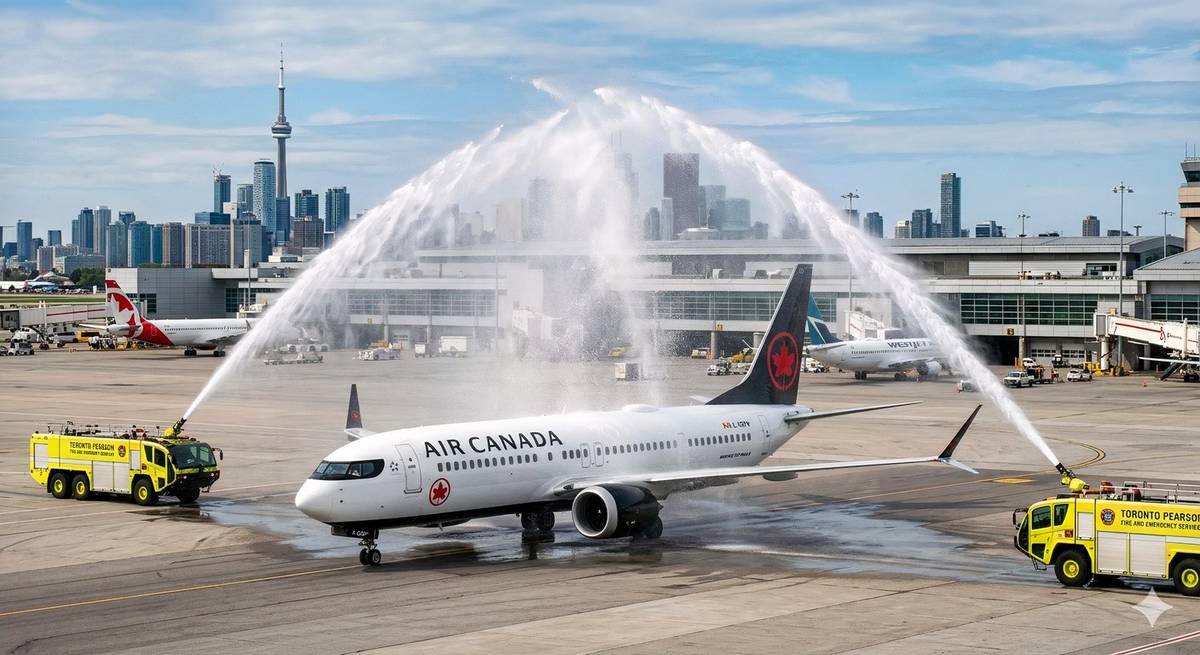
On June 10, Air Canada took off from Montreal to Nantes, with a three to four-weekly service, initially on the 737 MAX 8 but switching to the A321XLR on July 22. It competes directly with Air Transat, becoming the first time the market has had two carriers.
On June 11, Air Canada began service from Toronto to Ponta Delgada, which is in the Azores. The next day, WestJet introduced flights in exactly the same market. It is the first time that either airline has flown to the Portuguese archipelago.
Both carriers deploy the 737 MAX 8. However, while Air Canada runs three times weekly, WestJet will mainly have an extra weekly service. They compete directly with Azores Airlines. It is hard to imagine the relatively thin market having three carriers!
On June 12, Air Transat took off from Montreal to Agadir (weekly A321LR), followed by Montreal to Keflavik four days later (three weekly A321ceo). It marked the airline’s first time in Iceland, while it was the first time that any airline had operated between North America and the Moroccan coastal city and tourist destination of Agadir.
Finally, on June 13, Iberia took off from Madrid to Toronto, with a five-weekly A321XLR service. At 3,280 nautical miles (6,075 km) each way, it is the airline’s new fifth-longest XLR route this year, after Santo Domingo, San Juan, Recife, and Washington Dulles. On a block time basis, Toronto flights are timed at up to nine hours.
Mondays, Wednesdays, Fridays, Saturdays, Sundays
5:10 PM-6:50 AM+1 (seven hours and 40 minutes)
Alaska Airlines, Breeze Airways, Delta Air Lines, and United Airlines collectively inaugurated 15 routes between June 10 and 13. Alaska launched six, half of which had not previously been served by any carrier: Anchorage to Boise (two weekly 737-800 and 737-900ER), Anchorage to Boston (weekly 737 MAX 8), and Portland to Jackson Hole (two weekly SkyWest E175).
Breeze began four routes that have never been part of its network, half of which were brand-new: Pensacola to San Antonio and Raleigh/Durham to Atlantic City (both two-weekly on the A220-300).
Then there’s Delta and United. They started five routes, two of which were brand-new: Austin to Kalispell/Glacier Park (Delta; mainly weekly on SkyWest’s E175s) and Newark to Kalispell/Glacier Park (United; weekly 737 MAX 8).
Nearly half of them are brand-new, which is a significant proportion. Find out where’s now being served!
The startup airline Riyadh Air has finally launched official operations using its own Boeing 787-9s, rather than its spare aircraft. This has the carrier’s proper, official product. So far, four 787-9s have been delivered.
On June 10, the carrier inaugurated its first regular passenger-carrying service from the Saudi capital to London Heathrow. The ‘proper’ launch came sooner than originally planned. This route has been served since last year for slot-sitting purposes, but tickets were not available to the public. Now they are. A daily operation exists.
Two days later, the next route, to Jeddah, began. Initially flown twice daily, four daily flights will be available next month. Later this month, outside this article’s examined period, Riyadh Air will take off for Cairo and Dubai. In July, flights to Madrid and Manchester will begin.
Despite the ongoing war in Iran, Etihad remains in growth mode. Between June and December, the carrier plans to begin or introduce ten routes from its Abu Dhabi hub.
Four links began or resumed in the examined period: Damascus, Kraków, Palma de Mallorca, and Zanzibar. The Syrian capital was previously part of Etihad’s network in 2012, while the increasingly popular inbound market of Zanzibar was last served in 2023.
The large Polish city of Kraków, which is the country’s primary inbound tourist destination, and Palma are brand-new to Etihad’s map. Both routes are served three weekly using first-class-equipped, 160-seat A321LRs.
A comparison with the major market of Dubai, not far from Abu Dhabi, is worthwhile. Kraków has been served from the UAE’s busiest airport since 2018, with flydubai operating up to twice daily in 2026 using 737 MAX 8s. In contrast, Palma has never had Dubai flights.
Fast-Growing Wizz Air Launches A Near-Dozen More Routes
The pan-European ultra-low-cost carrier Wizz Air has introduced a further 11 routes. Flights from London Luton, which is the airline’s most-served airport, to Corfu began on June 10 (two-weekly). The next day, it took off from Luton to Lyon (three to four weekly) and Turin (three weekly); both are brand-new in the airline’s network.
On June 15, Wizz launched flights from Athens, Gdańsk, and Wrocław to the Bulgarian resort destination of Varna (all are served three to four weekly), along with Wrocław to Tirana (three weekly). Wizz has not previously served the two Polish routes to Bulgaria.
The following day, the carrier took off from Wrocław to Keflavik (three weekly) and Podgorica (four weekly), while it began flying from Barcelona and Debrecen to Varna (both three weekly). The links to Podgorica and the Hungarian city of Debrecen are brand-new to Wizz’s map. All the Varna routes materialized because the airline has based a third aircraft there.
Excluding Istanbul and the inbound beach hotspots of Antalya, Bodrum, and Dalaman, nearly ten million passengers flew between Turkey and Europe in 2025. Over half of the passengers flew indirectly, especially via Istanbul’s airports. Most passengers were traveling to visit friends and relatives.
Markets include Brussels to Kayseri, which is a large city in Central Anatolia and the gateway to the world-famous Cappadocia. More nonstop flights exist in 2026 than in any other year, which will easily grow the city pair’s 13,000 round-trip local passengers last year.
That is because of the return of TUI (two weekly; mainly 737-800 and 737 MAX 8), which data from Cirium, an aviation analytics company, shows last served the city pair in 2022. It competes directly with SunExpress, with both airlines broadly targeting the Turkish diaspora and inbound tourism.
As TUI will also operate in the winter, it’ll also target the growing demand for skiing in the region. Curiously, the airline has scheduled the E190-E1 on the route, which will cover a considerable 1,496 nautical miles (2,771 km) each way. The variant is due to operate on Tuesdays from November.
Orijinal Haberi Görüntüle