
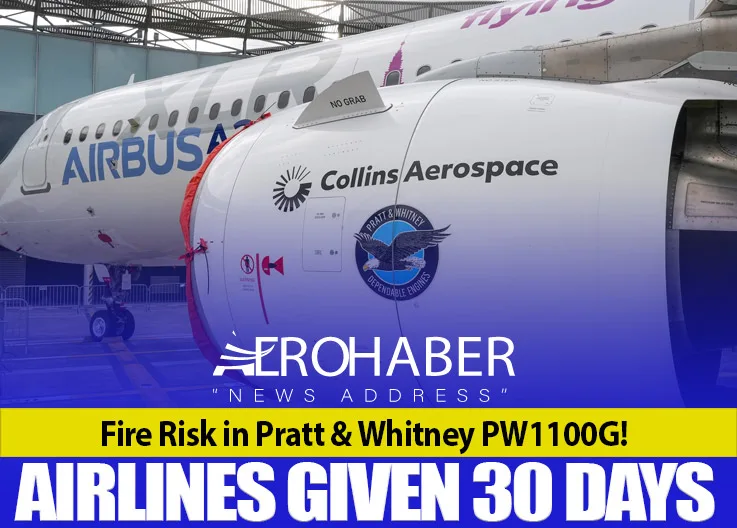


The US Federal Aviation Administration (FAA) has issued a new airworthiness directive (AD) for airlines following multiple fire incidents involving Pratt & Whitney PW1100G turbofan engines. Under the directive, the removal of fuel hose clamps and the replacement of certain fasteners have been made mandatory on hundreds of engines.
The AD published by the FAA on 12 January will come into force on 17 February. Airlines have been granted 30 days after this date to complete the initial maintenance actions.
Fire Risk Linked to Fan Blade Failures
In its statement, the FAA noted that the regulation was prepared following numerous reports related to fan blade failure incidents. It was stated that three of these events resulted in fires in the engine lower cowling.
The regulatory authority said:
“This AD has been issued to prevent fuel leaks that may result from fan blade failure.”
586 Engines Covered
The new AD covers 586 PW1100G engines installed on US-registered aircraft. PW1100G engines are one of the two engine options used on the Airbus A320neo family. The other option is the CFM International Leap-1A engines.
This development comes at a time when hundreds of aircraft worldwide have been grounded due to a separate issue affecting Pratt & Whitney’s PW1000G engine family, stemming from a manufacturing defect in metal components.

Previously Recommended, Now Mandatory
In the AD, the FAA reminded operators that Pratt & Whitney had previously recommended the necessary maintenance actions related to fire risk through service bulletins, but these actions were not mandatory at the time.
In a statement on the issue, engine manufacturer Pratt & Whitney said:
“This instruction is consistent with the actions outlined in previously issued service bulletins to operators and has been almost entirely implemented across the fleet.”
What Actions Will Be Taken?
According to the FAA’s directive, within 30 days from 17 February airlines must:
- Remove the ‘cushioned loop clamp’ associated with the fuel line assembly,
Then, at the first engine maintenance visit:
- Replace the thermal management system fasteners with redesigned parts,
- Renew the cushioned loop clamp with a new clamp.
According to Pratt & Whitney service bulletins, fan blade failures caused by factors such as bird strikes can lead to the breaking of thermal management system connections and cracks in fuel lines. Removing one of the clamps, as a temporary measure, can increase the flexibility of the line and reduce the risk of cracking.
125 Hours of Workload
The FAA estimates that the required maintenance actions will take approximately 125 labour hours per engine. This is expected to place an additional burden on airlines in terms of maintenance planning and operational continuity.