
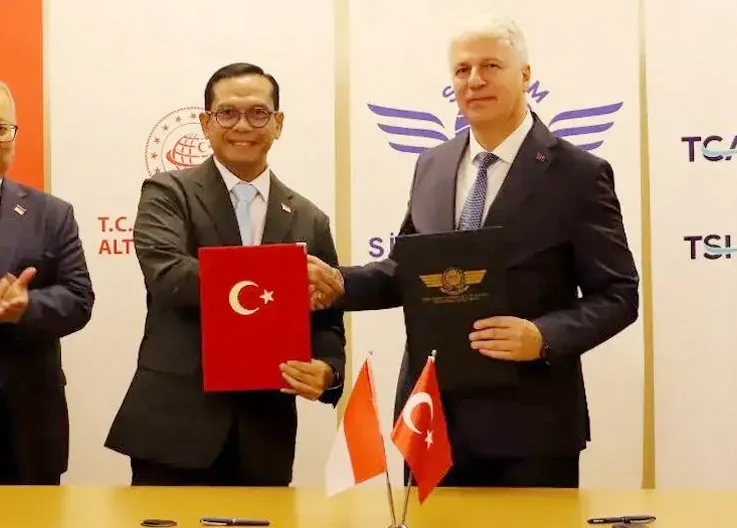


Türkiye and Indonesia are deepening their cooperation in air transport. The new agreement envisions an increase in the number of direct flights, the addition of new destinations, and greater operational flexibility for airlines.
An important step has been taken in civil aviation relations between Türkiye and Indonesia. The two countries have agreed to expand cooperation in air transport, open new flight routes, increase passenger capacity, and create stronger opportunities in tourism and trade.
The agreement was signed during the bilateral air services consultation meeting held in Istanbul on 22–23 October 2025. The Indonesian delegation was led by Agustinus Budi Hartono, Director of Air Transport at the Directorate General of Civil Aviation, Ministry of Transportation.
Agustinus stated to Antara News, “This meeting resulted in the signing of two significant documents — the Record of Discussion and the Implementing Arrangement — which strengthen air relations between the two countries.”
During the discussions, the commitments made by the leaders of both countries at the High-Level Strategic Cooperation Council (HLSCC) meeting held in Bogor on 12 February 2025 were reviewed. In particular, the goal of increasing direct flights between Türkiye and Indonesia was brought to the table.
The new agreement expands the flight network:
- In Indonesia: Yogyakarta, Majalengka, Manado, Medan, Balikpapan, Sorong, Kediri, and Lombok have been added to the existing Jakarta and Denpasar routes.
- In Türkiye: İzmir and Bodrum have been designated as new service points, in addition to Istanbul, Ankara, and Antalya.
Passenger capacity rights have also been significantly increased. Under third and fourth freedom rights, the weekly number of flights has been raised from 14 to 32. Agustinus emphasised that this increase was the result of “constructive dialogue that strengthens air connectivity and expands market access.”
Furthermore, both parties updated code-sharing arrangements, enabling third-country airlines to collaborate on longer routes between the two nations. This aims to improve operational efficiency, offer passengers more connection options, and allow airlines to expand their networks.
A new regulation regarding unused capacity rights also introduced flexibility. Accordingly, flight rights that remain unused by one party may be utilised by the other through commercial arrangements, subject to the approval of the relevant authorities.
Agustinus noted, “This arrangement allows airlines to make the best use of market potential without waiting for formal amendments to existing agreements.”
From an economic standpoint, Turkish airlines’ determination to deepen cooperation with Indonesia stood out. Within this framework, plans include the employment of more Indonesian pilots and cabin crew, the expansion of partnerships in maintenance, repair and overhaul (MRO), and the promotion of Indonesian tourism destinations through the Turkish Airlines network.
Agustinus highlighted the strategic importance of the agreement not only in terms of connectivity but also in strengthening Indonesia’s position in global aviation, stating, “This agreement opens the door to greater economic potential for our national aviation sector.”