


Pegasus Airlines Inc. shared its traffic and carbon emission statistics for September 2025 with the public. The company recorded a strong increase in both passenger numbers and operational efficiency, while also improving its carbon emission performance compared to the previous year.
20% Increase in Passenger Numbers
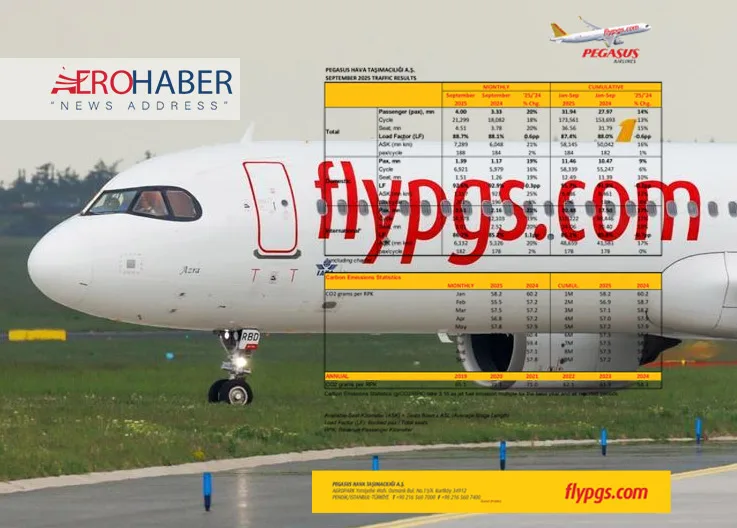
In September 2025, Pegasus carried a total of 4 million guests. This figure represents a 20% increase compared to the same period in 2024.
- Total seat capacity: 4.51 million (2024: 3.78 million, +20%)
- Load factor: 88.7% (2024: 88.1%)
- ASK (Available Seat Kilometres): 7,289 million km (+21%)
In the first nine months of the year (January–September 2025), Pegasus carried a total of 31.94 million passengers, achieving 14% growth compared to the same period of the previous year.
Strong Performance in Domestic and International Routes
In September 2025, the number of domestic passengers reached 1.39 million, while international passenger numbers totalled 2.61 million.
- Domestic Load Factor: 92.6%
- International Load Factor: 86.7%
- Domestic ASK Growth: +25%
- International ASK Growth: +20%
While load factors remained high across both segments, the increase in passengers per landing (+3% on domestic routes, +2% on international routes) reflected Pegasus’s success in capacity management.
Improvement in Carbon Emissions Continues
In line with its goals to enhance carbon efficiency and support sustainable aviation, Pegasus reduced its CO₂ grams per RPK value to 56.4 as of September 2025. This represents a 2.4% improvement compared to the 57.8 gr/RPK level in 2024.
During the first nine months of the year, the average carbon emission stood at 57.2 gr/RPK.
In carbon calculations, the jet fuel emission coefficient was fixed at 3.16 grCO₂/RPK for the base year and all reporting periods.
CO₂ gr/RPK trend between 2019–2024:
65.1 → 71.3 → 71.0 → 62.1 → 61.3 → 58.3
Focus on Sustainable Growth and Operational Efficiency
Pegasus Airlines Inc. continues to advance in 2025 in line with its goals of sustainable growth, operational efficiency, and improved environmental performance.